Friday, August 10, 2012
Suwarrow Atoll
From Bora Bora, we headed Northwest on a 680 mile passage to the atoll of Suwarrow, a park in the Cook Islands. We were so excited to finally be sailing toward an island so special that one man, Tom Neale, lived there alone for nearly 16 years and later wrote a book titled “An Island to One’s Self. 3 days and 23 hours of downwind sailing, jibing several times across the rhumb line, positioned us off the reef pass leading into Suwarrow’s huge lagoon. With the help of a few GPS waypoints, passed along by cruisers who had been there before, we safely entered the lagoon, steering clear of the shallow reefs between the entrance and the anchorage. As we approached the anchorage, we spotted 2 boats that had preceded us from Bora Bora by a few hours and one that had been there for nearly a week. We were immediately impressed by the incredible beauty of the area and the clearest water we’ve seen in the Pacific. As we maneuvered “Blue Rodeo”, looking for a perfect spot to anchor, we could clearly see jagged coral formations scattered around the sandy bottom 60 feet below us. Anchoring proved to be a bit of a challenge though due to the proximity of the other boats, depth of the water, numerous “bommies” (coral heads) and nearby, shallow reefs. Eventually, we found a suitable spot and securely set “Blue Rodeo’s” anchor on a sandy bottom relatively free of coral. When that was done, we tidied-up a bit and relaxed in our cockpit as the last of the afternoon light faded into a brilliant sunset.
The next morning, we were greeted by Harry and Anthony (“Ants”) who are rangers assigned this season to Suwarrow. Even though Suwarrow is part of the Cook Islands, it is administered by New Zealand and rangers occupy a simple dwelling on the atoll’s Anchorage Island for six months each year. They serve as both caretakers and officials proving customs and immigration services for visiting yachts. Over the years, other resident rangers had earned a fine reputation for their hospitality and Harry and “Ants” were living-up to it in every way. They spent an enjoyable hour with us, in “Blue Rodeo’s” cockpit processing the official paperwork associated with clearing-in to a foreign country and chatting about the atoll and what it’s like to live in such a place for so many months, relatively isolated fro the outside world. While the job of ranger in such an isolated place might be considered a punishment by some, they considered it a privilege.
Over the next few days, we would spend wonderful times with new and familiar cruising friends SCUBA diving, snorkeling, exploring, beach combing and sharing pot luck dinners ashore with the rangers. The scenery around us was a daily feast for our eyes and the pristine surroundings were just what we’d dreamed of when we fantasized about the South Pacific. Paradise had been found!
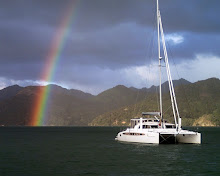
While our vision of paradise included gentle, warm breezes and sunny skies, the reality is that the weather in this part of the Pacific can often be less than perfect. While at Suwarrow, we experienced several days of high winds, and heavy rain. The rain sometimes fell with such intensity that our dinghy would fill with 6 inches of water in less than an hour. The island’s anchorage provides good protection from ocean swells but is open to significant fetch from the south through northwest. During the squalls, when we experienced southerly winds, the surface of the lagoon’s water became as rough as we often see on the open ocean, Despite the rough conditions, we continued to snorkel daily and take trips ashore where we visited with our friends in the protection of the dense palm forest and a cruiser’s shelter. A daily highlight was the feeding of sharks on the east side of the small island. We would follow the rangers to a beach there where they, for our entertainment, would dispose of food scraps by throwing them to sharks that swam by. Within minutes, the water would be boiling with, Black Tip, White Tip and Grey sharks competing for the offerings. While aboard our boats at anchor, we would also often be circled by numerous sharks seeking any tidbits that we might throw overboard or flush from our sink drains. Though menacing in appearance, the sharks showed little interest in us and caused us little concern on our daily snorkeling excursions.
While snorkeling and SCUBA diving at the atoll’s numerous reefs, we were especially impressed by the otherworldly coral formations. In some areas, jagged coral pinnacles rose from the depths nearly to the surface looking like stalagmites in a cave. Due to the water clarity with visibility of 150 feet or more, it was possible to take-in an amazing panorama. At times, while many feet below the surface, we felt like we were flying through air amidst a landscape resembling Utah’s Monument Valley. While the coral formations never failed to amaze us, we were often surprised by the lack of large fish in the lagoon. This led us, and our fellow divers, to speculate as to the reason. Was it due to overfishing in the years before the atoll became a park? Was it due to the large number of sharks? Or, perhaps was is it related more to natural phenomena, like the full moon period we were in, that the big fish were there and chose to not be seen. As we continued to dive daily, we were happy to see more and more fish in various places and began to feel that this special, undersea environment was fairly healthy and, that with continued protection, will remain one of the most pristine places on our planet.
Before we knew it, we had been at Suwarrow for 11 days and, even though we were enjoying it so much, we felt the irresistible pull of the exotic locations up ahead. So, after bidding a warm farewell to the rangers and cruising friends who would stay a bit longer, we raised “Blue Rodeo’s” anchor an set sail for another island. Though sorry to leave, we tingled with excitement knowing that new discoveries were ahead and that more adventures awaited us.
Monday, July 23, 2012
Huahine and Raiatea
Our sail from Moorea to Huahine required an overnight passage and some
motor sailing due to very light winds. The trip was very pleasant though
and throughout much of the night we had the lights several other cruising
boats in sight. Our first glimpses of Huahine in the early morning light
revealed dramatic mare’s tails of spray blowing off the tops of huge waves
breaking over the island’s barrier reef. The gentle, rolling swells from
the southwest that lifted “Blue Rodeo” as they passed were creating quite
a sight as they collided with the shallow reefs. When it came time to
enter the reef pass leading to our destination, an anchorage near the
village of Fare, we were treated to the spectacle of surfers riding waves
as we surfed our boat through the entrance into the lagoon’s protected
waters. Before long we were at anchor and enjoying the amazing scenery.
During the next few days, large waves continue to break over the nearby
reefs constantly filling the lagoon with water that would then flow back
to sea through the channel where we were anchored. This created a
constant current that kept “Blue Rodeo’s” bow pointed toward shore and
made swimming from the boat challenging at best.
A shore-side exploration with friends Craig and Bruce revealed a charming
little town with friendly people and neatly kept houses. Compared to
Tahiti and Moorea, Huahine sees few tourist visitors and we felt fortunate
to be there to enjoy the simple island life. Our exploration revealed an
extremely well-stocked grocery market giving us an opportunity purchase
fresh fruit, vegetables and other supplies that we’d need for the weeks
ahead.
On our second day, we shared a car rental with Craig and Bruce and took a
driving tour around the entire island visiting several restored
archeological sites, and a pearl farm. Our drive also became a quest to
locate and feed the island’s famous blue-eyed eels. Prior to leaving
town, Anne had purchased several cans of mackerel which, we were told, was
favored by the eels. After asking directions, we zeroed-in on a drainage
canal, still wondering where exactly to find the eels. Another clue came
in the form of a trash can filled to the brim with empty mackerel cans.
As we peered into the canal, still unable to see the eels, several local
children approached and politely asked for our cans hoping to participate
in the fun. We were happy to observe and let them do the dirty work.
Canned fish in hands, they scampered down into the canal where they lured
the eels from their hiding place under a bank and created a feeding
frenzy. We watched in amazement as the 4 to 5 foot long, blue-eyed
creatures swam, slithered and writhed around the children greedily
gobbling up chunks of mackerel. It was obvious that the children had done
this many times before and were, despite the eels’ menacing teeth, totally
unafraid of them. Anne couldn’t help but get involved in the action and
joined-in, even petty one of the eels as it fought for her mackerel. She
remarked “eeww…they’re slimy!”
Days at Huahine were spent snorkeling the nearby reef and evenings ashore
socializing with many familiar and newly-made cruising friends at a
waterside restaurant that offered a splendid view and great happy hour
specials. After drinks, we would often eat at one of the nearby
“Roulottes” (food trucks) where we found the best poisson cru we’ve ever
had served by a jolly and chatty local named Albert and prepared by his
hard-working wife.
The high point of our Huahine stay was watching the town’s young men and
women rehearse for and perform at the annual Heiva celebration. This
celebration of life festival goes on throughout the islands of French
Polynesia every July and participants spend months perfecting their
dancing, and drumming. While attending one of the rehearsals at a school,
were greeted warmly by the group’s instructor who made a special point of
making us feel welcome and explaining the history and significance of the
dance moves. We enjoyed it so much that we attended another rehearsal and
stayed at the island an extra day to watch the final presentation with the
group in full costume. While we were aware that bigger, more elaborate
productions took place on the Island of Tahiti, we felt that our
experience was so wonderful due to our being well off the tourist beaten
path.
With more islands to see and time on our 90 day visa ticking off, we left
Huahine and sailed next to beautiful Raiatea where we would spend just two
days anchored inside its lagoon swimming, snorkeling and exploring the
most significant Marae (archeological site) in Polynesia. There we saw
elaborate stone construction made of huge slabs of coral harvested from
the reefs by building fires at low tide and using the heat to fracture the
coral. We can hardly imagine the effort required but it certainly makes
us appreciate the importance of these ceremonial areas to the people that
built them.
A second night was spent anchored by ourselves off a palm-covered motu
where we snorkeled in crystal-clear water and returned to “Blue Rodeo” for
a quiet, relaxing evening enjoying the sunset and each other’s company.
Our perfect evening was, however, made less so when Mark dropped one of
his contact lenses down our head’s sink drain. Instead of lounging in our
cockpit and cuddling with his lovely bride, he spent the next several
hours on hands and knees, struggling in a confined space, disassembling
enough of the drain plumbing to successfully retrieve his contact lens.
Oh well, there will surely by more opportunities ahead for sunsets and
romantic evenings as we continue our travels.
Wednesday, July 18, 2012
Bora Bora
After awaking at our peaceful anchorage inside the lagoon on the west side
of the island of Raiatea and completing plumbing repairs resulting from
Mark’s lost contact lense episode, we set sail for the fabled island of
Bora Bora. From the aerial photos we’d seen of it and from descriptions
and reports from friends who had been there, we knew that out 24 mile sail
would take us to one of the most beautiful island in the world. The
island’s lush, green interior mountains are surrounded by a blue lagoon
and a number of palm-covered motus (islets). It is on these motus that
some of the world’s most exclusive and exotic hotels can be found making
it a destination of choice for honeymooners and celebrities looking for a
romantic, tropical getaway. Because most of the lagoon areas near the
island’s main town of Vaitape are either reef-strewn or too deep to anchor
comfortably, most cruising yachts choose to tie-up to moorings that are
offered at several locations. The most popular are located at the Bora
Bora and Mai Kai Yacht Clubs. Moorings are typically constructed of very
heavy nylon line spliced around a steel thimble and chained to a concrete
block weighing several tons that is dropped to the sea floor. Throughout
the word, in areas without conventional marinas, moorings are frequently
found. After sailing through Bora Bora’s reef pass, we proceeded directly
to the Mai Kai Yacht Club where we found an available mooring and secured
“Blue Rodeo” to the mooring line using our 1” diameter nylon bridal.
Once were we settled, we took our dinghy ashore to check in with the
club’s staff and were pleased to find that they were offering a week’s-
worth of free moorage to attract business to the facility and dock-side
restaurant. Knowing that many boats would be arriving within the next few
days to take-in the island’s Heiva and Bastille Day celebrations, we felt
fortunate to get a spot near the center of the action.
While in the Tuamotu’s at the atoll of Fakarava, we had purchased a
package of guided SCUBA dives from a dive operation that also had a
location in Bora Bora and saved several dives to use there. With a
forecast of increasing winds and deteriorating weather for the area, after
checking-in with the club, we wasted no time in arranging two dives each
for the following morning.
The next morning, the dive boat picked us up at our boat a raced out of
the reef pass to our first dive site. Along the way we had a chance to
get to know several of the other divers in our group and compared notes
about our favorite dive locations around the world. The two dives we did
that morning were enjoyable but not especially interesting. We are
realizing that we’ve been a bit spoiled by the Tuamotu’s with the
incredible variety of corals, fish and multitude of sharks. On our second
dive outside of Bora Bora’s surrounding reef, we did see two large Lemon
sharks that definitely got our attention as they have somewhat of an
aggressive reputation and look more menacing than the more common, Black
and White-Tipped Reef sharks.
Over the next several evenings we connected with cruising friends for
dinners ashore and walks into town to watch the nightly dance
performances. Throughout the week, the weather remained unsettled with
strong winds and frequent rain showers that prevented us from ever getting
to totally see and appreciate the beauty of our surroundings. The wind
gusts, many in the 30 knot range, that funneled down off the nearby
mountains would send “Blue Rodeo” and neighboring moored boats sailing
back and forth while straining at their mooring lines. Several times
daily, Mark would go forward to the bow of our boat and examine the
condition of our mooring line and attachment bridal. Despite this effort
a failure of one of our lines nearly resulted in disaster.
While ashore one evening with a group of friends watching the dance
performances, we noted wind gusts even more extreme than we’d experienced
during previous days. One cruiser would later mention that his
instruments registered a wind speed of 53 knots. While walking with our
group back to the Yacht club, we encountered another cruising friend
running toward us, nearly out of breath, who reported the shocking news
that “Blue Rodeo” had broken free of her mooring and gone adrift into the
very dark and stormy night. In a second, our hearts sank and our minds
raced as we considered the awful consequences. Had our floating home
collided with another vessel? Had she been blow onto a reef where she was
being battered and broken by the wind-driven waves? Fortunately, before
the shock set in, our friend included the information that “Blue Rodeo”
had been rescued by other cruisers and anchored around a point near the
Bora Bora Yacht Club.
The next 30 minutes proved to be agonizing as we hurriedly returned to our
dinghy at the Mai Kai. With winds howling and a heavy rain beginning to
fall, we were happy to accept the assistance of the club’s owner would was
waiting for us with his large, high-powered, inflatable boat to take us to
“Blue Rodeo”. While towing our dinghy, he shuttled us back to our
anchored boat where went found 3 of our heroic cruising friends huddled
out of the rain under our cockpit awning. Upon our arrival, they gave us
a brief summary of what had happened and returned to their own boats for a
well-deserved sleep. It goes without saying that we gave them our most
sincere and heartfelt thanks. Before they left, plans we made get
together the next day to hear the whole story.
Our night aboard “Blue Rodeo” at anchor was less than restful as we were
buffeted by severe wind gusts. We awoke many times to cross-check our
position with GPS coordinates and lights ashore to insure that we were not
dragging our anchor.
The next day, we returned to our original mooring and re-secured “Blue
Rodeo” with another stout mooring bridal and a back-up line. Once that
was done and we were confident that the boat was safe, we walked over to
the Bora Bora Yacht club where we learned exactly what had happened and
continued to thank those involved with the rescue. As it turns out, a
young, female chef at the club had been driving home along the coastal
road when she noticed “Blue Rodeo’s anchor light and cockpit lights in an
area not normally transited by boats, especially at night. Fortunately,
she had the good sense to call the club and alert them that a boat was
possibly adrift. Had it not been for her call, it’s likely that the
strong winds would have blown ‘Blue Rodeo” across the lagoon and onto the
leeward reef where she would have been severely damaged. When the young
woman’s call came in, the club manager alerted several cruisers who
actually accomplished the rescue. John, from the vessel “Red Sky”, was
first to respond aided by Pedro and Mark from the vessel “ La Condesa del
Mar”. With their dinghies lashed alongside our wayward boat, they were
able to tug her to an area clear of other vessels where they could pull
out our anchor chain, hand-over-hand, from its locker and drop the anchor,
securing the boat until we arrived. Considering the strong winds, driving
rain and very dark night, their accomplishments were nothing short of
heroic and we will forever feel the utmost gratitude toward them. Later
reflection on the incident made us feel so very fortunate to be traveling
in company with so many wonderful, competent and caring folks. Of course,
had the situation been reversed, where another vessel had been in
jeopardy, we would have been quick to lend a hand. After all, that’s what
cruisers do…that’s what the cruising community is all about.
of the island of Raiatea and completing plumbing repairs resulting from
Mark’s lost contact lense episode, we set sail for the fabled island of
Bora Bora. From the aerial photos we’d seen of it and from descriptions
and reports from friends who had been there, we knew that out 24 mile sail
would take us to one of the most beautiful island in the world. The
island’s lush, green interior mountains are surrounded by a blue lagoon
and a number of palm-covered motus (islets). It is on these motus that
some of the world’s most exclusive and exotic hotels can be found making
it a destination of choice for honeymooners and celebrities looking for a
romantic, tropical getaway. Because most of the lagoon areas near the
island’s main town of Vaitape are either reef-strewn or too deep to anchor
comfortably, most cruising yachts choose to tie-up to moorings that are
offered at several locations. The most popular are located at the Bora
Bora and Mai Kai Yacht Clubs. Moorings are typically constructed of very
heavy nylon line spliced around a steel thimble and chained to a concrete
block weighing several tons that is dropped to the sea floor. Throughout
the word, in areas without conventional marinas, moorings are frequently
found. After sailing through Bora Bora’s reef pass, we proceeded directly
to the Mai Kai Yacht Club where we found an available mooring and secured
“Blue Rodeo” to the mooring line using our 1” diameter nylon bridal.
Once were we settled, we took our dinghy ashore to check in with the
club’s staff and were pleased to find that they were offering a week’s-
worth of free moorage to attract business to the facility and dock-side
restaurant. Knowing that many boats would be arriving within the next few
days to take-in the island’s Heiva and Bastille Day celebrations, we felt
fortunate to get a spot near the center of the action.
While in the Tuamotu’s at the atoll of Fakarava, we had purchased a
package of guided SCUBA dives from a dive operation that also had a
location in Bora Bora and saved several dives to use there. With a
forecast of increasing winds and deteriorating weather for the area, after
checking-in with the club, we wasted no time in arranging two dives each
for the following morning.
The next morning, the dive boat picked us up at our boat a raced out of
the reef pass to our first dive site. Along the way we had a chance to
get to know several of the other divers in our group and compared notes
about our favorite dive locations around the world. The two dives we did
that morning were enjoyable but not especially interesting. We are
realizing that we’ve been a bit spoiled by the Tuamotu’s with the
incredible variety of corals, fish and multitude of sharks. On our second
dive outside of Bora Bora’s surrounding reef, we did see two large Lemon
sharks that definitely got our attention as they have somewhat of an
aggressive reputation and look more menacing than the more common, Black
and White-Tipped Reef sharks.
Over the next several evenings we connected with cruising friends for
dinners ashore and walks into town to watch the nightly dance
performances. Throughout the week, the weather remained unsettled with
strong winds and frequent rain showers that prevented us from ever getting
to totally see and appreciate the beauty of our surroundings. The wind
gusts, many in the 30 knot range, that funneled down off the nearby
mountains would send “Blue Rodeo” and neighboring moored boats sailing
back and forth while straining at their mooring lines. Several times
daily, Mark would go forward to the bow of our boat and examine the
condition of our mooring line and attachment bridal. Despite this effort
a failure of one of our lines nearly resulted in disaster.
While ashore one evening with a group of friends watching the dance
performances, we noted wind gusts even more extreme than we’d experienced
during previous days. One cruiser would later mention that his
instruments registered a wind speed of 53 knots. While walking with our
group back to the Yacht club, we encountered another cruising friend
running toward us, nearly out of breath, who reported the shocking news
that “Blue Rodeo” had broken free of her mooring and gone adrift into the
very dark and stormy night. In a second, our hearts sank and our minds
raced as we considered the awful consequences. Had our floating home
collided with another vessel? Had she been blow onto a reef where she was
being battered and broken by the wind-driven waves? Fortunately, before
the shock set in, our friend included the information that “Blue Rodeo”
had been rescued by other cruisers and anchored around a point near the
Bora Bora Yacht Club.
The next 30 minutes proved to be agonizing as we hurriedly returned to our
dinghy at the Mai Kai. With winds howling and a heavy rain beginning to
fall, we were happy to accept the assistance of the club’s owner would was
waiting for us with his large, high-powered, inflatable boat to take us to
“Blue Rodeo”. While towing our dinghy, he shuttled us back to our
anchored boat where went found 3 of our heroic cruising friends huddled
out of the rain under our cockpit awning. Upon our arrival, they gave us
a brief summary of what had happened and returned to their own boats for a
well-deserved sleep. It goes without saying that we gave them our most
sincere and heartfelt thanks. Before they left, plans we made get
together the next day to hear the whole story.
Our night aboard “Blue Rodeo” at anchor was less than restful as we were
buffeted by severe wind gusts. We awoke many times to cross-check our
position with GPS coordinates and lights ashore to insure that we were not
dragging our anchor.
The next day, we returned to our original mooring and re-secured “Blue
Rodeo” with another stout mooring bridal and a back-up line. Once that
was done and we were confident that the boat was safe, we walked over to
the Bora Bora Yacht club where we learned exactly what had happened and
continued to thank those involved with the rescue. As it turns out, a
young, female chef at the club had been driving home along the coastal
road when she noticed “Blue Rodeo’s anchor light and cockpit lights in an
area not normally transited by boats, especially at night. Fortunately,
she had the good sense to call the club and alert them that a boat was
possibly adrift. Had it not been for her call, it’s likely that the
strong winds would have blown ‘Blue Rodeo” across the lagoon and onto the
leeward reef where she would have been severely damaged. When the young
woman’s call came in, the club manager alerted several cruisers who
actually accomplished the rescue. John, from the vessel “Red Sky”, was
first to respond aided by Pedro and Mark from the vessel “ La Condesa del
Mar”. With their dinghies lashed alongside our wayward boat, they were
able to tug her to an area clear of other vessels where they could pull
out our anchor chain, hand-over-hand, from its locker and drop the anchor,
securing the boat until we arrived. Considering the strong winds, driving
rain and very dark night, their accomplishments were nothing short of
heroic and we will forever feel the utmost gratitude toward them. Later
reflection on the incident made us feel so very fortunate to be traveling
in company with so many wonderful, competent and caring folks. Of course,
had the situation been reversed, where another vessel had been in
jeopardy, we would have been quick to lend a hand. After all, that’s what
cruisers do…that’s what the cruising community is all about.
Saturday, July 7, 2012
Moorea
Day 2 of the Pacific Puddle Jump group’s rendezvous at the beautiful island of Moorea was a full one with dance and craft demonstrations as well as numerous sporting activities for the cruisers to participate in. The premier events were the outrigger canoe races. Men and women from our group divided into 4 person teams to compete while assisted by two skilled locals who help steer and keep us out of trouble. While neither of us were on winning teams, we gave it our all and had a wonderful time. A feast of traditional Polynesian cuisine was served midday followed by more sports and an awards ceremony. Due to our 4th place finish in the rally/race from Tahiti the previous day, we were awarded the prize of a 4-wheel drive vehicle island tour. We were thrilled!
When the events of the day concluded, most everyone returned to their boats for a quiet evening aboard. What began as a quiet and peaceful evening was soon to change.
Around 10pm, as were were about to climb into bed, we stepped into “Blue Rodeo’s” cockpit to enjoy, for a few more minutes, the warm, tropical breeze and twinkling stars above. Mark noted that a few clouds had begun to move into the area and that lightning was visible in the distant southeast. Soon after, we felt the first sprinkles of a rain shower and scampered about closing our boat's hatches. As often happens in the tropics, the gentle rain quickly turned to a downpour and visibility dropped to a few hundred feet. Suddenly, the wind began to blow with great intensity and, within moments it was absolutely howling. As Mark moved through the cockpit, straining his eyes to see the boats upwind of us, he glanced at our wind speed instrument that was reading 40.8 Knots (about 45 miles per hour). In the darkness, we could see that several boats, in the crowded anchorage upwind of us, were dragging their anchors and in serious trouble. Our anchor was holding fast but we quickly started “Blue Rodeo’s” engine and shifted into forward gear to relieve some of the strain on the anchor and give us a bit of maneuverability in hopes of dodging any boats that might come toward us. During the downpour and shrieking wind gusts, we could see several boats careening by, wildly out of control. Some collided with others and a few managed to miss other anchored boats by mere inches. At one point, a woman’s voice, who we knew to be that of a solo sailor, called out on the VHF radio with an urgent plea for help. While we desperately fought to avoid nearby boats, others, who were less vulnerable, bravely took to their inflatable dinghies and raced about in the blackness offering help where they could. After what seemed like an eternity, but was probably only 20 to 30 minutes, the worst of the storm had passed and lights were seen on decks of boats all around us as crews assessed damage and re-anchored. At some point near midnight, our adrenalin rush subsided enough for us to go to bed a get some sleep.
Mark’s sleep was interrupted at 5am though when he awakened to find that the wind was once again building in strength and, even worse, had shifted direction by 180 degrees. Two nearby boats, one that had blown by during the storm just missing a coral reef and another boat, were now coming together and had fouled each others' anchor chains. The one trying to raise anchor and move away needed help so Mark quickly launched our dinghy and raced over to help untangle the mess. Within a few minutes, the boats were apart and one was slowly motoring away to another part of the bay. That area, where many of those that had dragged anchor ended up, became jokingly know as “Drag Queen Bay” during the next day’s many radio conversations among the fleet. When all was said and done, it is very fortunate that no one was injured and that no boats were lost. It was though, an episode that we don’t ever care to repeat.
Compared to the excitement that night, the next few days were rather peaceful and relaxing. We took our 4-wheel drive tour, along with several friends, and visited some spectacular overlooks, pineapple and vanilla plantations, archeological ruins and a distillery were we sampled some delicious, locally made, flavored rums.
Our remaining days in Moorea were spent doing the usual boat chores, socializing, snorkeling and visiting the famous Bali Hi Hotel in nearby Cook’s Bay. We have seen some truly beautiful places on our South Pacific adventure but is is hard to imagine that we will come across any that offer the same dramatic skyline, lush green hills and vivid blue waters that we found here. Oh well, we guess that we’ll just have to keep moving on, searching for the next paradise.
Monday, July 2, 2012
Tahiti
A two night and one day sail in brisk winds and lumpy seas brought
us from the atoll of Toau in the Tuamotu Archipelago to the reef pass leading
to the famous city of Papeete, Tahiti.
From our reading, and information passed along by other cruisers, we
knew that Papeete was a busy, noisy and rather commercial town that was no
longer the vision of unspoiled, tropical paradise. Never the less, we were excited to be there
as it gave us the opportunity to re-provision at real supermarkets and to
purchase a few items for “Blue Rodeo” at a well-stocked, marine hardware
store. We had been sailing for several
months around the sparsely populated islands of the Marquesas and Tuamotus so
being back in “civilization” also allowed us to indulge ourselves in a
restaurant meal or two.
We had been traveling at a fairly fast pace hoping to see as
much as possible and still make it to Tahiti in time for a three-day rendezvous
party, put on by “Latitude 38” magazine and the Tahiti Board of Tourism, for
the fleet of “Pacific Puddle Jumpers” that were making the crossing this
year. As we motored into the crowded
anchorage about 5 miles south of downtown Papeete, we were pleased to see many
familiar boats and good friends including Larry and Karen, of the yacht “Phanta
Rei”, who had come there two weeks early to have their water maker
repaired. As soon as we were securely
anchored, they picked us up by dinghy and shuttled us to the nearby marina
docks where we could start a shore-side exploration. In their company, we stopped first at a
nautical chandlery (hardware store) and then walked a short distance to, of all
places, a McDonalds where we treated ourselves to “McFlurry” soft ice cream
deserts. Next, it was off to the
Carrefour supermarket where we experienced sensory overload perusing isle after
isle of fresh fruits, vegetables, meats and cheeses. Just imagine a store similar to a US
Wal-Mart, but with a French flavor.
After a provisioning reconnaissance run, we all climbed aboard a city
bus for a trip to the downtown area.
After two seasons of riding busses in Mexico, where they are usually
driven through traffic at hair-raising speeds and often lack functioning
shock-absorbers and mufflers, we were unprepared for the Tahitian bus
experience. We have to say that although
the ride was much quieter, smoother and more comfortable, it lacked the
adrenalin rush that we had come to expect from public transportation in Mexico.
Once downtown, we walked around a bit, getting oriented,
then headed to a large parking lot adjacent the waterfront that is transformed
each night into a culinary venue that has become a “must experience” for Tahiti
visitors. Around sunset, the lot fills
with mobile kitchens (food trucks known as “roulottes”) that serve an
assortment of tasty, reasonably-priced meals ranging from poisson cru to
burgers to all of the usual Chinese dishes.
We all enjoyed an assortment of our favorite Chinese specialties at one truck
and finished with chocolate waffles and crepes, complete with ice cream and
whipped cream, at another.
Over the next several days, we greeted more arriving
friends, shared stories of our sailing experiences this season with them and
took another trip into the downtown area to shop at the huge city market.
On our last evening in Papeete, we gathered with fellow
“puddle jumpers” at the Tourism Center for a welcoming ceremony that included
refreshments and a fine Polynesian music and dance exhibition. When the dancers concluded there routine,
some of our group of uncoordinated, mostly over-the-hill cruisers were coaxed
onto the dance floor where we made attempts to mimic the rhythmic moves of the
pros. We were embarrassed by our lack of
skills but had great fun never- the-less.
Day two of the “Puddle Jump Rendezvous” began with a 20
mile, group rally/race From Tahiti to the beautiful island of Moorea where the
group would anchor for another day of festivities. While the sail was intended to be a relaxed,
no-pressure rally rather than a race, there was an official signal from a
starting gun and, since it’s usually the nature of most sailors to want to
“race” any other boat that they see on the water, most everyone seemed intent
on sailing their floating homes with as much speed as possible. When signing-up for the event, we had been
asked to take two passengers who worked for the Board of Tourism. As most of the fleet proceeded out of the
harbor to the starting line, we were left behind waiting for our
passengers. When it was determined that
our passengers had been accommodated on another boat, we were late and had to
scramble to raise our sails and start sailing after the fleet that was already
underway. Starting about 10 minutes late
gave us the challenge of overtaking those ahead. Fortunately, windy conditions of 18 to 22
knots from our starboard quarter were just what we needed to sail “Blue Rodeo”
near her full potential. What fun it was
knifing through the group, overtaking boats one by one! Even though Mark has limited racing
experience and Anne even less, we sailed like a well –honed, America’s Cup team
spurred on by Anne’s inner competitive instincts. When the race concluded, we crossed the
finish line in fourth place out of 27 boats behind a 55’ performance catamaran,
a 57’ mono hull and a 44’ catamaran that unashamedly admitted that they had left
Papeete early.
The exciting day concluded with a cocktail reception and social gathering on the beach near our anchorage at Moorea’s spectacular Opunohu Bay. Sharing good times with so many wonderful people in such a beautiful place…wow, how fortunate we are
Thursday, June 21, 2012
Toau blog
After just three days anchored off the village of Roatava near the north
end of Fakarava's huge lagoon, we set sail for the atoll of Toau. Several
hours of pleasant sailing in perfect conditions positioned us outside
Otugi Pass on the atoll's southeast side. We had read reports of the
channel through the reef being dangerous with strong currents and breaking
waves often extending several miles out to sea. Since our arrival did not
coincide perfectly with slack tide, we did see a large area of water
disturbed by the outflowing current. Fortunately, negotiating the
entrance proved easy enough by staying near the edge of the pass and
avoiding the worst of the choppy water. Once inside, we anchored off a
picturesque motu among lots of irregular-shaped coral formations. Once
again, we buoyed our anchor chain to reduce the possibility of snagging
and damaging the living coral. We were soon joined by fellow cruisers
aboard "Southern Cross", Gato Go", "Island Bound" and "Buena Vista". The
next several days would be spent snorkeling in the passes, beach combing and sharing
good times with our friends. During one morning's snorkeling excursion in
the pass, where we let the incoming currents sweep us repeatedly through
the entrance, flying like supermen over the colorful coral gardens, we
were treated to an encounter with a large, curious Manta ray. It seemed
as interested in us as we were in it so we swam in its company for quite
some time before it descended out of view. We never grow tired of
watching these amazing creatures "up close and personal". Another close
encounter though was a bit unnerving. When separated a ways from Mark,
Anne was approached by a sizable Lemon shark that came too close for
comfort prompting her to quickly climb back into our dinghy and call out
to Mark with concern. When Mark approached and was informed of the
presence of the shark, Mark's response was to say "cool... I want to see it
...which way did it go". Maybe that was just another example of the
difference between girls and boys or, perhaps, good commons sense or lack
thereof. Never the less, Mark was disappointed that he didn't get to see
the magnificent creature.
Soon it was time to leave the deserted motus near Passe Otugi and sail
outside the atoll to a spot on the north shore known as Anse (cove) Amyot.
The sail began with perfect wind and weather conditions that deteriorated
as we approached our destination. Dark clouds began appearing on the
horizon all around us and soon we were overtaken by squalls with copious
amounts of heavy rain. We were, once again amazed by how quickly the
squalls can materialize here in the tropical South Pacific and the
intensity with which rain can pour from the skies. Most often, the
squalls pass quickly. Unfortunately for us, the greatly-reduced
visibility caused by the heavy rain was complicating our plan to enter
Anse Amyot's narrow reef pass and moor in its sheltered water before dark.
While waiting for the squall to pass, we hovered just outside the reef
straining our eyes to see the channel markers ahead and the few other
cruising boats already inside. After a radio conversation with friends
Craig and Bruce on the catamaran "Gato Go", who had preceded us by about
an hour, we felt confident enough to proceed in. Because of Anse Amyot's
small size and shallow, coral reefs on three sides, anchoring there is
difficult. So, 12 moorings have been placed inside the cove by the
couple who operate a restaurant there. Our task would be to locate one
of only two unoccupied moorings in the fading light and heavy rain and
secure "Blue Rodeo" without hitting a reef or playing "bumper boats" with
those already moored. Fortunately, all went smoothly and before long, we
were attached to a heavy mooring line by our nylon bridal and breathing
soggy sighs of relief.
Our stay at Anse Amyot would be made especially memorable by the charming
couple, Valentine and Gaston, who live there and operate a small pearl
farm and simple, open-air restaurant. Other cruisers had informed us that
the opportunity to have a meal ashore with them was not to be missed. The
morning after our arrival, we took our dinghy ashore for introductions and
were soon invited, along with the other cruisers in the cove, to share a
wedding anniversary dinner with our hosts that night. Dinner proved to be
quite the extravaganza with cruisers bringing dishes to share and
Valentine and Gaston providing grilled lobster, octopus curry, and a
seafood Paella. When we arrived, a table for nearly 30 had been set under
a backyard tree. Dinner lasted well past our bed time but we had a fine
time meeting a number of European cruising couples and doing our best to
communicate in common languages. Fortunately, English was spoken by most
but we have vowed, once again, to devote some time and effort to learning
to speak French. During the meal, several small, but intense, squalls
with strong wind gusts sent us scurrying for cover and crowding under a
patio awning. The next morning we would learn that a boat, sailed by a
couple from Finland that we had meet at dinner, had broken free from its
mooring and nearly ended-up on the nearby reef during one of the squalls.
We all shuddered to think how close they came to losing their floating
home. After diving later to examine the failed mooring, it was determined
that the coral head, to which the mooring was chained, had actually broken
off sending the boat adrift. Thoughts of this sort of thing can sure lead
to some sleepless nights out here.
Over the next several days, we did a few SCUBA dives outside of the
atoll's reef where we enjoyed the clearest water we've yet experienced in
the South Pacific. The great visibility allowed us to view the dramatic
contours of the coral reef and underwater canyons that would drop away
into the nearby abyss. Our only disappointment was not seeing any large
sharks or pelagic fish cruising by in the deep water. Is it possible that
we are getting too accustomed to diving with sharks?
Before leaving Anse Amyot, Anne would spend several hours ashore examining
Valentine's assortment of beautiful, black pearls and watching her implant
(graft) nuclei into live oysters around which pearls would form. We even
had the opportunity to open our own oysters and recover the small,
iridescent treasures inside. Rather than buy more pearls, Anne was able
to trade men's shirts, scarves and food items from "Blue Rodeo's" galley
for a few that will always remain as precious mementos of our visit to
Toau.
With a rendezvous in Tahiti with fellow "Pacific Puddle Jumpers" planned
for June 22nd, it was soon time to prepare "Blue Rodeo" for another open
ocean passage. Our last day at Toau concluded with slipping away from our
mooring, raising our sails and heading south west as the late-afternoon
sunlight illuminated the atoll's palm-covered motus. Tahiti here we come!
Subscribe to:
Posts (Atom)