Tuesday, January 24, 2012

New Year 2012


During the last week of December 2011 we left “Blue Rodeo”
safely in the Riviera Nayarit Marina in La Cruz de Huanacaxtle, Mexico and flew to Los Angeles for a Christmas
holiday visit with Mark’s family. We had
a splendid time, made extra special by
the fact that all of Mark’s siblings were able to be there for the
festivities. When we flew back into the
Puerto Vallarta airport on December 30th, we were met by dear
friends Howard and Lynn from the sailing vessel “Swift Current”. We’ve truly begun to think of them as part
of our family so the return felt like another home coming. We learned that our friend Karen had been
organizing a New Year’s Eve celebration to be held at her cute little home near
the marina. The next day, Anne met Karen
at the local fish market and they bought a giant, 5 kilo (approximately 11 pounds) bag of fresh shrimp while ogling the large and often
unidentifiable fish on the tables around them.
New Year’s Eve was spent at Karen’s casita gorging on peel ‘n eat shrimp
and Caesar salad. After dinner, we all
moseyed into town to listen to live music and dance in a restaurant’s outdoor
courtyard. Howard cut up the dance
floor, spinning and twirling the ladies until their arms were almost pulled from
their sockets. Lynn said that her
husband’s dance moves had often left his partners on the verge of nausea. Afterwards,
we took a walk along the marina’s
breakwater to watch the midnight
fireworks display. Considering that we
are often in bed by 10pm, partying until past midnight made us all feel young
at heart.
Several days later, we decided to take a driving trip up the
coast to the quaint little surf resort town of Sayulita. On the way, we stopped at another beach town
named San Pancho. It is a small village
with several charming hotels, a number of gorgeous private homes and a few restaurants shaded by dense palm
groves. Before sitting down for a scrumptious lunch, we
strolled along the pristine, white sand beach watching large breaking waves
crash onto the shore. Last year we were
only able to spend a few minutes in Sayulita so this year we were anxious to
check it out a bit more. It also has a
large beach but it is quite crowded with wanna -be surfers and a more
alternative lifestyle crowd. Sayulita is
a perfect venue for people watching and
touring the eclectic shops and galleries.
The town is also known for hosting winter yoga retreats for folks
looking to escape the cold weather up north.
The next day we once again piled in the car and headed to
downtown Puerto Vallarta where we walked its famous and colorful malecon (beach
front promenade). Lunch at an out of
the way restaurant with a fern grotto-like patio was both delicious and
entertaining when our waiter treated us to several clever napkin tricks.
In the time between sight-seeing trips, Mark kept busy readying “Blue Rodeo” for our upcoming travels. With our South Pacific departure now less
than 3 months away, he is feeling a bit overwhelmed by his never-completed to
do list. Steady progress is being made
though and we are sure that we will be as ready as can be when the time
comes. That week, Mark also spent hours
and hours studying and taking practice
tests to prepare himself for a Ham radio license exam that was being offered in
near- by Puerto Vallarta. He
successfully passed the test so we can now fully utilize one of the long range
communication radios that we have aboard our boat.
On Sunday January 8th, longtime friends from
Seattle, Carol and Bevin, flew down for a visit. After introducing them to our favorite spots
in La Cruz and doing some last-minute provisioning, we set sail for an
overnight passage down the coast to the small town of Chamela. We
have grown so fond of La Cruz, and especially our friend Karen who lives there,
that saying adios was even more difficult this time. Our plan is to return
there in February to begin provisioning and final preparation for our South
Pacific crossing but sadly, Karen will be off on her own sailing adventure
crewing on a boat heading through Central
America and the Panama canal.,
Our trip south with Bevin and Carol began on an exciting
note when while dodging groups of frolicking hump back whales, we managed to catch several fish on our
trolling lines. The biggest one stripped
most of the line from one of our reels and put up quite a fight. While Mark did his best to steer the boat and
slow it down while keeping an eye out for whales in our path, Anne and Bevin took turns fighting the fish
and slowly bringing it close enough to be gaffed and brought aboard. Carol scampered about with cameras in-hand
documenting the action from as many angles as possible. The fish, that we hoped was a Yellow Fin tuna,
appeared to weigh between 30-35 lbs and was the biggest we’ve caught while
sailing. A determined effort on the part
of all four of us was needed to subdue the flapping beast and eventually cut it
into thick fillets. By the time we were
finished there was blood splattered all over the back of our cockpit and
transom and a lot of time and effort was spent cleaning up the mess. After the fish was bagged and in the
refrigerator and things had settled down a bit, our group began using our fish
identification books and charts to more thoroughly investigate the exact kind
of fish that we had caught. While it did
indeed have yellow fins, we were dismayed to learn that it was just an
exceptionally large Jack Carvalle which, we know from experience, are not very
good eating. In the end, we returned the
meat to the sea where it would become food for some other creatures and felt
bad about killing the fish. As it turns
out though, the fish had completely swallowed our lure so it’s unlikely that it
would have survived, even though we managed to remove the large hook from its
mouth.
As we sailed into the evening with a fair wind pushing us
swiftly toward our destination, Anne and
Carol prepared dinner as the first light of the full moon began to rise over
the coastal mountains. We all dined in
the cockpit while “Blue Rodeo’s” trusty autopilot did the steering. When dinner was finished and the dishes done,
we settled into a rotation of watches that would give everyone a chance to get
some sleep during the night. With the moonlight
sparkling on the water around us, the night-time hours seemed to pass quickly
as we all reveled in the natural beauty.

Monday, January 16, 2012

December 2011 Blog


Our time anchored at Punta de Mita was really special this year. From time spent there last season, we knew our way around the town and what was available. The day after our arrival, we dinghied to the beach and took the short walk into town to replenish our supply of fresh fruit and vegetables. While walking from a pickup truck mobile produce stand, we talked about how we needed to get in touch with Karen, a friend from last year, who lives in nearby La Cruz. Suddenly, in one of those strange coincidences that make you go… “hmmm”, we heard a car honk its horn and lo and behold if it wasn’t Karen behind the wheel. She said she was there to do some stand-up paddle surfing with friends. After exchanging hugs, we all decided to go for drinks at a beachside palapa restaurant where we met several more of her friends from the area. It was such a fun afternoon. The next two days were spent stand-up paddle surfing and Anne, on her first day, caught two good waves, riding them all the way to the beach. Quite an accomplishment for her first day of surfing! She later exclaimed that she is now hooked! Back aboard “Blue Rodeo”, we enjoyed relaxing evenings and beautiful sunsets. Looking forward to a few more days there, we were disappointed one morning to discover the batteries that provide power to all of our household systems were not performing as usual. Mark did some checking and found we had a bad cell in one of the batteries affecting the ability of the others to hold a proper charge. This was not good news and we knew we had better head into the marina in La Cruz right away to check it out.

Although we were disappointed to leave Punta de Mita earlier than planned, we were happy to arrive in La Cruz as it is one of our favorite places on the mainland. The marina is very cruiser friendly and the little town is full of surprises. It is known for having great music from such locals as Brian Savage and Philo Hayward and an assortment of wonderful dining experiences with an eclectic mix of restaurants. On Sundays there is a large outdoor market just outside of the marina. Anne loves to go exploring there and usually returns to our boat with all kinds of goodies ranging from chocolate tamales to jewelry. After settling into a marina slip and checking in with the office, we couldn’t wait to explore the town and see what had changed since last year. After reacquainting ourselves once again, Mark got down to the serious business of determining exactly what was going on with those darn batteries. After exchanging emails and speaking to good friend Steve, it was decided new batteries were in order. Steve referred us to a distributor in Guadalajara where we might find the specific, somewhat unusual model of batteries we needed. Mark immediately emailed them and received a timely reply in broken English reporting that they did indeed have them in stock. Our friend Karen, who is fluent in Spanish, helped confirm by telephone that the batteries were available in as little as two day’s time. The next step was to arrange for transportation. Mark remembered a Brit named Mathew who had a van service and enlisted his services for the drive to Guadalajara and back. We invited Karen and sailing friends Lynn and Howard to join us and departed the next Monday morning. Mathew has taken many tourists to Guadalajara and was the perfect tour guide. We traveled in a very comfortable, new Toyota, 10 passenger van. He had the trip planned to drive the coastal route on the way over, via the quaint distillery town of Tequila. We stopped there and had a leisurely lunch and a walk about. After piling back in the van, we drove the rest of the way to Guadalajara where Mathew’s wife’s family owns a small hotel in the university district of the city. Upon arrival, we checked-in and headed out for an evening of exploring. With Christmas just days away, the city was bustling with energy. Shoppers and revelers were everywhere as were lots of street vendors and performers. We visited the huge municipal market that extended for several blocks and was 3 stories high. Every square inch was packed with merchandise varying from flowers, both fresh and artificial, to produce and merchandise. It had everything you could imagine for sale. One whole floor was devoted to electronics. We meandered through the tightly packed lower floor, feeling a bit claustrophobic, and managed to find Mark’s four year old niece a traditional dress, in the color of the Mexican flag, for Christmas. As we continued to stroll about the town, we enjoyed all the wonderful decorations hung above the streets. An interesting thing we noted was all the shops with clothing for christenings, girl’s coming-of-age parties, weddings and formal balls. We had never seen anything like it. The “people watching” was fabulous and we ended up taking loads of pictures. Karen took us to a great little dinner spot written up in the Lonely Planet travel guide which we really enjoyed. Afterwards, we walked back to the hotel and settled in for the night.

The next morning the boys drove off to find the batteries while the girls went in search of coffee. Upon meeting up, we were happy to learn that the batteries were indeed in stock and we now had them in our hot little hands. What a relief! With that weight off of our minds, we then departed for the nearby market town of Tlaquepaque. We walked around the town, which is famous for artwork, crafts and furniture, and saw amazing works from the local artisans.

After lunch, it was back on the highway driving through beautiful agricultural areas as we followed the two lane road as it climbed into the jungle-covered mountains. Our return route to Puerto Vallarta would take us through several small and historic towns. The last several hours were spent negotiating the narrow and winding road after dark. Boy, were we glad someone else was doing the driving. By 8:30pm we were back at the marina unloading our four, shinny, new batteries weighing 128 pounds each. By early the next morning, the batteries were installed in “Blue Rodeo” and happily supplying power to our electrical system. The excursion to obtain them had been an enjoyable adventure and the time elapsed from when we determined that we needed new batteries until when they were installed was just six days. We would later learn that others had been waiting for over six weeks for locally ordered batteries to arrive from the States. I guess we’ll continue to count our “lucky stars”.

Monday, December 12, 2011

La Paz to Banderas Bay


Our drive from La Paz to Idaho went well and before long we found ourselves back in the mountains making final preparations for our return to Mexico for the winter. We took care of administrative chores, said “so long” to good friends and, after getting a ride down to the Boise airport, joined the southbound geese on their winged migration. Our flight schedule allowed a few enjoyable days in Los Angeles visiting Mark’s family before continuing down to La Paz.

We arrived back at the boat in Marina Palmira and were immediately impressed by the number of new arriving cruising sailors including our good friends Howard and Lynn of the vessel “Swift Current”. It was such a pleasure reconnecting with them and sharing all sorts of activities around the town. New friends Mark and Wendy from the vessel “Wendaway” were docked next to us and we were so happy to have the opportunity to get to know them better.

Our plan had been to finish a few boat projects and head out as soon as possible to enjoy some of our favorite spots in the Sea of Cortez before sailing across to the mainland. Well, as often happens, things always take longer than planned. Paint work on “Blue Rodeo’s” deck was delayed by strong winds, and a new antenna mount that Mark had designed came back from being bent, welded and polished looking beautiful but with mounting and cable routing holes drilled in the wrong places. Mark would spend hours and hours making corrections so it would fit properly. With projects slowly being checked-off the list, we found that Thanksgiving was rapidly approaching so the decision was made to stay in La Paz through the end of November. This gave us time to share a few more evenings out with our ever-increasing circle of friends including Bill and Dianne of the vessel “True love”. Their good company was always appreciated and
Bill’s computer charting wizardry helped Mark with issues he was having running a new program on his Mac computer. While we worked and socialized, another period of strong, northerly winds came and went and finally it was time to cast off the dock lines for the first time since coming to the marina in late July.

Once underway, we set our sails and steered a course for Bahia de los Muertos, a lovely bay with a beautiful sandy beach and a resort development that is struggling due to the economic downturn. There are several spectacular homes within the complex that have been completed along with a hotel, golf course and two restaurants. We had a great three-day stay in the bay except for one night when, after the wind quit, we found ourselves lying at anchor crosswise to strange and lumpy swells that caused the boat to roll unmercifully. That night, despite our best efforts to silence tools, pots and pans and anything else that wasn’t screwed down from clanking, creaking and banging, we found sleep nearly impossible due to the noise and the motion. It’s often said that “misery loves company” so, at least, when we looked across the anchorage at Howard and Lynn’s boat and watched its wild gyrations, we knew that we’d get a good laugh the next day while comparing the awful night.

From Muertos, we had a fast and pleasant downwind sail to Bahia Los Frailes, our planned jumping-off point for the crossing to the mainland. We arrived there in the fading light in building northerly winds that would keep us pinned-down aboard our boats for most of the next 4 days. At times, we noted wind gusts as high as 37 knots in the anchorage but, the wind blew almost directly offshore and we remained comfortable.
Despite the strong winds, we managed to do some swimming and snorkeling in the clear water that, at 78 degrees was almost ten degrees warmer than the air. Finally, the winds subsided giving us and the “Swift Current” crew the opportunity to dinghy ashore for a strenuous hike to the top of a rocky crag overlooking both Bahia Los Frailes and Cabo Pulmo to the north.

With the weather forecasts obtained from the daily SSB radio “net” conversations indicating favorable conditions for a crossing, we set out for Banderas Bay on the Mexican mainland’s jungle-covered “Rivera”. By 4:20am the next morning, we had raised anchor and sails and we sailing swiftly across the Sea of Cortez. “Swift Current” followed closely behind and we remained in sight of them for the entire 38 hour crossing. Conditions could hardly have been better. The wind remained brisk in the 15 to 20 knot range from just aft of our port beam allowing us to sail effortlessly at speeds up to 10 knots. Sea conditions, although somewhat lumpy, were moderate making the ride comfortable and a nearly full moon lit the seas around us during the night with such brilliance that it almost seemed like daylight. By the following evening, as we entered Banderas Bay, we parted company with Lynn and Howard and anchored at Punta de Mita as the sun slipped below the horizon. Lynn and Howard continued the remaining few miles to the anchorage at La Cruz.

Our time on the Baja side of the Sea of Cortez had been magical with clear water and beautiful beaches framed by the back-drop of spectacular desert scape and rugged mountains. Arriving back on the mainland side reminded us though how much there is to appreciate here. Sure, there are more people, bigger cities and more hustle and bustle but beauty is everywhere and the communities we visited last year were welcoming, the people friendly and the food delicious. Uh oh, there go our waistlines!

Saturday, November 12, 2011

Season Three...Return to Mexico


Season three of the “Blue Rodeo” adventure started off in a way neither of us planned. In preparation for our winter cruising in Mexico and next spring’s South Pacific crossing, we purchased a gasoline powered scuba compressor and a 14’ long, carbon fiber whisker pole. With “Blue Rodeo” already in La Paz, near the southern end of the Baja Peninsula, getting these two large items to the boat presented a challenge. The use of a truck transport company was a possibility but we had heard horror stories about items being held-up in customs for weeks and excessive importation duties being charged. Due to size and hazardous material limitations, flying the items down on an airline flight was also ruled-out. Ultimately, we decided to make the 4800 mile roundtrip drive from McCall, Idaho to La Paz and back and personally insure that the items arrived safely. Once the decision to drive was made, it also gave us the flexibility to load-up on some of our favorite foods from Trader Joes and huge cases of US quality paper towels from Costco. The trip proved to be a splendid adventure. We left McCall on the morning of the October 12th, driving Highway 95 most of the way to our first overnight stop in Fallon, Nevada. The next day we continued to Chatsworth, California where we spent two nights with Mark’s family. From there, it was on to Oceanside after first going to San Diego for last minute shopping at the many boat stores there. We spent both that night and the next with sailing friends Cathy and Lee from the J-130 “Sirocco. Prior to continuing south, we shared a wonderful evening of friendship and excellent food with Lee, Cathy, Dave and Marisa from “Pacifico” and Mike and friend Michelle from “So-Inclined”. The next morning, we left before the sun was up to meet with three other sailing friends from Mark’s days in Ventura, California, with whom we’d caravan down to La Paz. Jeff and Anne from “Outrider” and Ken from “Bungee”, many-time veterans of the Baja drive, were also driving back to their boats and we were happy to have the opportunity to tag along and learn from their experience. After rendezvousing with them, we headed for our border crossing point, the small town of Tecate, about 30 miles east of San Diego.

Having secured a Mexican temporary import permit for “Blue Rodeo”, we should be allowed to bring boat related parts and accessories into that country without paying duty. But, since the rules are often interpreted differently by various officials, our biggest concern upon reaching the border was that our overloaded car would be thoroughly searched and we would have to pay duty on the items we were bringing in. This could potentially amount to a tax of many hundreds of dollars and so we were greatly relieved when the customs inspector, on the Mexican side of the border, allowed us to pass through even though we were given a random, red light to stop. We breathed a huge sigh of relief and felt like we had dodged a bullet. After a fairly brief and straight-forward stop in Ensenada for our tourist visas, we continued on the four-hour drive to the town of San Quintin enjoying the unique scenery along the way. For the most part, the road conditions were very good but there were a couple of places that roadwork was being done and we found ourselves having to leave the pavement, bouncing along through the desert dirt and sand like we were participants in the Baja 1000 off-road race. We stopped for the night at a cute little hotel just off the main highway where we paid just $35.00 for our comfortable room. We were all tired and the hotel’s restaurant was closed so, after checking -in, we volunteered to drive back into town and pick up some chicken “al carbon” (grilled) with tortillas and salad and bring it back for everyone’s dinner. What a feast!

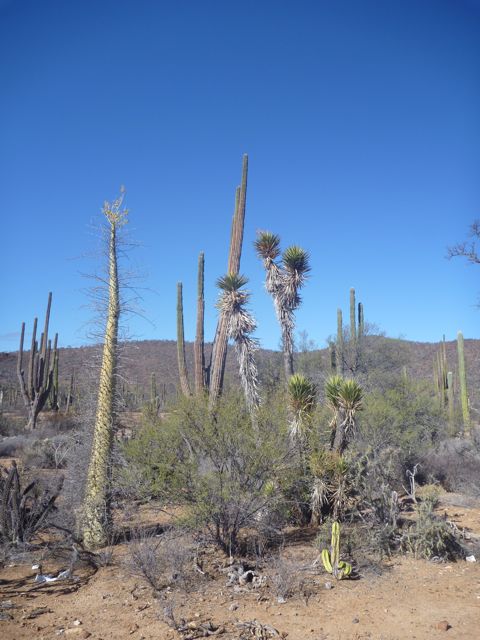
The next morning dawned cool and crisp as we climbed into our vehicles for a full day of driving. Our goal was to reach the town of San Ignacio where we had reservations at the Desert Inn. The drive, although quite long, proved to be breathtaking. It was amazing how much the landscapes changed along the way. Each valley and range of hills had its own unique topography, vegetation and lighting. We were particularly impressed with an area named Catavina with its boulder-strewn landscape and beautiful cacti. In Catavina, the soil is scarce and the landscape is littered with rounded rocks varying from marble-size to bigger than a house. The boulders are shaped by blowing sand that gives them a smooth, rounded appearance. Nestled in and amongst the boulders are hundreds of species of cactus, many found nowhere else in the world. The largest, the Cardon, is the world’s largest and often mistaken for the Saguaro found in the U.S. desert southwest. The Cardon can grow to 70 feet tall and weigh up to 25 tons while storing up to 1 ton of water at any given time. They can live as long as 300 years and are very slow growing. Another unusual cactus, found only in the Sonoran Desert is the Elephant cactus of which there are two types. The Boojum, which look like upside-down carrots and can live up to 500 years, dividing in two after 100 years and the Cirio, similar to the Boojum but living only 20-30 years. On our way home, we took time to stop and take lots of pictures of this colorful region. We found the small towns and settlements along the way also fascinating. It is hard to imagine that people live year-round in such an inhospitable climate. During the drive, we encountered another rather long area of roadwork and had to drive along the side of the road for several miles, once again, bouncing over large chunks of gravel and occasionally feeling our car transition into 4 wheel drive when hitting a particularly soft patch of sand. All in all, the driving took lots of concentration but was quite entertaining. After what seemed like forever, we arrived in San Ignacio, a small town famous for whale watching tours in the nearby lagoon. On the way back, we would spend another night there and walk from our hotel into the tiny town where we enjoyed an evening having dinner and an ice cream while watching boys and young men playing volley ball in the town square with a soccer ball. They turned out to be surprisingly good players. While in town, we also walked through, and photographed, the impressive cathedral that dated back to the 1700s.

Day 3 ended up being the longest drive of all because we elected to continue on to La Paz rather than spend an overnight in Loreto. After departing San Ignacio, we followed the highway as it climbed over a tall and rugged mountain range and descended to the Sea of Cortez side of the peninsula offering spectacular views of the beautiful areas we explored by boat in the spring and early summer. We stopped for a late breakfast at “Bertha’s” Cafe in Bahia Concepcion’s El Burro cove where we had eaten several times while anchored in the bay. We also hoped that we might see Lynn and Howard of “Swift Current” who had e-mailed us the night before that they would be arriving there late that morning by boat. Alas, our rendezvous didn’t happen then but did in Loreto a week later on our way northbound, when we had lunch with them and excitedly shared plans for the cruising season. After breakfast at Bertha’s, we once again continued south and found ourselves enthusiastically exclaiming about the majestic scenery, especially with the Sea of Cortez views. Since there had been recent rain from summer thunderstorms, the landscape was, in places, more lush than most areas we had traveled through. The terrain along this section was quite rugged, bordered by the Sierra Gigante Mountains to the west. Along this stretch, the driving became more of a challenge as the road was often quite narrow and without any shoulders or guard rails. Passing the occasional semi truck was rather harrowing and its easy to see how a small lapse in concentration of either party could result in tragedy. One of the things that got our attention was the number of the roadside memorials to loved ones that had perished along the way. They varied from primitive crosses with flowers to masonry houses and marble plaques. We wanted to photograph a few of them but to do so would be to risky as they were often in the most dangerous places along the roadside and nearly impossible to get to. One thing we forgot to mention was the military checkpoints along the highway, five in all, from just south of the border to just outside of La Paz. At the checkpoints, the road was barricaded so vehicles had to stop and submit to inspections for weapons and drugs by the Mexican Army. The check points were manned by young men, toting automatic rifles and sidearms. We would later learn that they were often not provided with ammunition. They lived in encampments along the side of the road that were poorly equipped and primitive at best. Apparently, Mexico requires its young men to serve for a year in the military to earn full citizenship and be eligible to procure a passport to travel outside of the country. At the checkpoints, one may or may not be searched depending on how you are perceived (profiling). We submitted to cursory searches each time, as did the travelers in front of us. Typically, this entailed searching the glove compartment, floor mats and the occasional bag.

The final leg of the day transited a broad agricultural basin with the dusty cities of Insurgentes and Constitution before climbing over another range of hills and descending
toward La Paz. The last narrow and twisting stretch was made all the more interesting by a semi truck speeding along in front of us while shedding chunks of tire from a retread that was coming off. By the end of the day, we arrived at Marina Palmira where “Blue Rodeo” waited peacefully. We are so happy to be back at the boat but we couldn’t relax yet as the whole car and our precious cargo had to be unloaded. After numerous trips with a dock cart, everything was unloaded and we breathed a happy, if overheated sigh of relief.

We would spend the next five days toiling in the heat and humidity, stowing gear and working on projects before “saddling-up” for the drive back to the States. We were anxious to take the car home and button-up our house so that we could return to the boat and feel like “real cruisers” once again.

Sunday, July 24, 2011

Isla Danzante to La Paz...end of the season


After a two day re-provisioning stop in Puerto Escondido where Anne was plagued each night by bites from noseeums, we motored a short distance to Isla Danzante where we found the picturesque anchorage at Honeymoon Cove to be unoccupied. Due to shallow water close to shore and rocky cliffs that line the anchorage, there is normally room for just one or two boats and we had to pass it by on our northbound leg. We carefully maneuvered “Blue Rodeo” into the cove and set our anchor while marveling at the majestic desert scape around us. Shortly after anchoring, we heard a disturbance in the water nearby and were amazed by the sight of dozens of large Moebli Rays chasing small bait fish that schooled while seeking protection in our boat’s shadow. The rays put on quite a show that lasted for 15 minutes or more before herding their prey into other areas of the bay. The next two days were spent snorkeling in the aqua marine water and climbing to the top of one of the mountains adjacent the anchorage. The views from above of “Blue Rodeo” nestled into the island’s tiny cove were simply amazing. While hiking ashore, we came across a pattern of small rocks carefully laid out to form the words “Will you marry me?”. We knew from having read a short note in the online version of our favorite sailing magazine, “Latitude 38”, that cruising acquaintance Byron had proposed to his girlfriend Jessica on that spot a few months earlier. We met them in Sausalito on our way down from Seattle and again in San Diego before crossing the border to Mexico. We can’t imagine a prettier spot for a proposal and wish them a long and happy marriage.

From Isla Danzante we continued down the Baha peninsula to another small and narrow anchorage called Candaleros Chico. Once again, we found it unoccupied and smiled at our good fortune of having the beautiful place all to ourselves as we dropped our anchor facing into a light southeasterly breeze. After a quick lunch we donned our snorkeling gear and eagerly swam the perimeter of the cove checking out the underwater scenery. Back aboard, while relaxing in the cockpit, we both drifted off to sleep and enjoyed pleasant, but short, naps. As we awakened, the winds were beginning to shift to the northeast and soon we experienced building, wind-driven chop entering our anchorage and swinging us around toward the shallow water near the beach. Even though we were safely anchored, we knew that if the winds continued to build from that direction the anchorage would become quite bumpy and we would be in for a miserable night. With regret, we opted to raise our anchor and continue another 20 miles down the coast to Bahia Aqua Verde, a larger bay with protection from more wind directions.

We found five other cruising boats already anchored in the north part of Bahia Aqua Verde. We spent a comfortable night there watching goats traverse the steep and rocky cliffs around the anchorage and watching another DVD movie before bed. The next morning, with the forecast of strong southerly winds, we opted to follow several of the other boats about a mile down the coast to another small bay that offered better protection from that wind direction. “Champagne”, one of the boats owned by new friend Larry King (not the creepy one) whom we had met a few days prior at Bahia Ballandra, organized a pot luck dinner aboard his boat and shared, as main course, a sizable yellowfin tuna that he had just speared. It was a fabulous feast and we especially enjoyed meeting three other couples who are veteran Mexico cruisers and friends of Larry from Puerto Escondido. When we returned to our boat after dark and prepared to raise our dinghy out of the water, we were surprised to find a large pelican sitting on our foredeck. After taking his picture, Mark had to give him a gentle, but assertive nudge to help him through our lifelines and back into the water. He certainly didn’t seem too concerned about us sharing his deck space. Amazingly, the next afternoon, while under sail, a pelican would again come aboard for a visit. Could it possibly have been the same bird? Or, could the first bird have passed the word that we were a pelican-friendly boat?

The forecast for southerlies was accurate and we spent the next 48 hours listening to winds in excess of 25 knots howl through “Blue Rodeo’s” rigging. After the winds subsided, we took the opportunity to hike and explore a nearby canyon before moving our boat to another cove closer to the village of Aqua Verde. This gave us the opportunity to snorkel in the clear water near an offshore rock and to re-visit the village where Anne stocked up on fresh tortillas and a few vegetables. While anchored there, we were pleased to see friends John and Pat arrive with their boat “The Rose”. They had 3 guests aboard and, after a morning snorkeling excursion, we joined them aboard their boat for brunch.

An afternoon sail down the coast took us to Punta San Telmo where we anchored alone just a few yards from a rugged, rocky point. After setting our anchor, we took our dinghy out to the point where we snorkeled looking for a suitable fish for dinner. The fish were not cooperative and we used our onboard provisions for dinner that night with plans to try again another time. The next morning, while Anne helped look for the big ones and tended the dinghy, Mark was able to spear a good-sized Leopard Grouper that would yield delicious fresh fish for several dinners. After our fishing trip, we took our dinghy ashore and went for a long hike over a ridge to a neighboring cove. Like Los Gatos, just a mile farther south, this bay was surrounded by magnificent orange and red colored sandstone cliffs. After a long hike in the midday heat, we stopped for a quick skinny dip to cool down before returning to our boat. As we approached our anchorage , we noticed another sailboat anchoring near ours and, although happy to share the space, we opted to raise our anchor and motored south to the next bay where we could, once again, have the place all to ourselves. We have enjoyed the camaraderie of the many fine cruising friends that we have made this season but also find being alone at anchor quite a treat.

The next day was another travel day down the coast to the southwest corner of Isla San Jose where we anchored just off the beach. The deserted beach showed promise for an exploratory walk and possible shell collecting. Within moments after dragging our wheeled dinghy onto the beach, Anne was rewarded with the find of a near perfect Paper Nautilus shell. These beautiful and intricate shells are prized by collectors and we eagerly continued our beach walk hoping to find more. Alas, no more were found that evening, nor the next morning at another stretch of beach a few miles away. Although disappointed at not finding more, we feel that our find is all that more special. The next day, we sailed 5 miles west to the village of San Everisto where we anchored just long enough to dinghy ashore and make another quick provisioning stop at a small tienda. We managed to find a head of lettuce and a few potatoes and cucumbers to augment our stores of fresh produce. From there, it was across the channel once again to Isla San Francisco, a favorite stop of ours on our northbound leg. We managed to find adequate protection from the southerly winds that continued to blow and spent two nights there swimming, snorkeling and hiking to the top of the rocky ridge overlooking the anchorage. We were also entertained by the antics of owners and guesta from several large motor yachts that anchored nearby. They seemed to be really living it up water skiing, wake boarding and inner tubing behind high speed launches and wave runners. While not exactly our style, we were happy to see that they were having lots of fun and not just sitting aboard watching movies in some resort marina. Our next stop on the way back to La Paz would be the Ensenada Grande anchorage on Isla Partidida. While sailing toward the island, Mark saw what he believed to be the dorsal fin of a Killer Whale. Not quite sure if they were found in these waters, he assumed that it was probably that of another species until moments later when we clearly saw first two, then four Killer Whales rise up under our dinghy that we were towing just 12 feet behind “Blue Rodeo’s” transom. Anne quickly grabbed our camera and we were able to film some video of the encounter as the whales playfully rolled on their sides and seemed to scratch themselves on the dinghy’s bottom. One even disappeared under our hull and Anne believes she felt a slight bump as it may have made contact with us. It was a bit disconcerting but a thrill that we’ll remember always! Before long, the creatures departed, probably in search of their next meal or something more fun to play with.

The next two days were spent anchored in Ensenada Grande trying to stay cool in the near 100 degree heat. We lost count of the times we went for a swim, often treading water on the shady side of the boat seeking relief from the intense sun. At one point, we took the dinghy to an offshore rock about 2 miles away where we planned to do some snorkeling. While approaching the rock and anchoring our dinghy, we were greeted by several huge bull sea lions that didn’t seem pleased by our intrusion into their space. On our northbound leg, we had snorkeled with sea lions at nearby Isla Islotes, a place frequented by tourists, but these sea lions seemed less comfortable with human contact and made it clear that we were unwelcome. Rather than disturb them to the point of them becoming aggressive, we chose to pull up our anchor and go elsewhere for our afternoon of snorkeling. Later that night, we welcomed the arrival of the evening Coromuel winds that brought relief from the intense heat. “Blue Rodeo” is well equipped with a fair number of cabin and cockpit fans but, until the winds arrived, we felt as though we were slowly being cooked.

The next morning, we departed early and raised our sails to take advantage of a fresh southeasterly breeze. As we pointed the boat toward Puerto Ballandra where we would spend our last night at anchor before entering the marina in La Paz. By late morning, the wind had died and we were forced to start our diesel engine and begin motoring to our destination. Before long however, the steady song of our engine changed note and we observed a small fluctuation in rpm. With fuel flow being Marks first concern, he quickly entered our engine room to examine the pressure gauge on the engine’s fuel filters. Everything seemed normal so we relaxed for a bit until the rpm fluctuations worsened. As a precaution, Mark switched to another fuel tank and the engine operated smoothly for about another 20 minutes until it quit completely. At this point, despite a lack of significant wind, we were very happy to be aboard a sailboat knowing that we could make it to an anchorage or into port under sail power alone if necessary. While Anne busied herself adjusting our course and trimming sails, Mark went below to assess the fuel situation knowing that it was possible that our tanks did not get filled completely the last time we had added fuel and that we had simply run out of fuel. He decided to open the tanks’ inspection ports to visually determine how much fuel remained. The port side tank, the one being used when the engine quit, was showing only about one and one half inches of fuel left at the bottom. We knew that with the boat sailing along at a slight angle of heel, that fuel may be unusable. Inspection of the starboard tank revealed a similar amount of fuel but it seemed to be contaminated and about the color of black coffee. This was the only tank to which fuel was added during our last fuel purchase and we began to wonder if we had taken on some bad fuel. With restarting the engine unlikely, we made a plan to sail to Bahia Falsa near the La Paz ferry terminal where we could anchor and travel by dinghy to the fuel dock at Marina Costa Baja to purchase fuel in our plastic jerry jugs. The plan worked well and, with a cooperative 10 knots of northerly wind, we arrived in the bay by late afternoon and smoothly dropped and set our anchor while dropping our main sail. Once the anchor was set, Mark jumped into the dinghy and hurried to the fuel dock, purchased 10 gallons of fuel and returned to “Blue Rodeo”. Before long our engine was purring once again and we backtracked a few miles to our original destination for the night of Puerto Ballandra. After the afternoon’s trials, we enjoyed a relaxing evening at anchor and awoke early the next morning to give the boat’s bottom a thorough cleaning and replace zinc anodes on the propeller, shaft and strut. Having accomplished those tasks, we concluded our cruising season with a short trip down the bay to La Paz’s Marina Palmira. We had made a reservation there for a slip until mid October and, after securing our dock lines, gave “Blue Rodeo” a well-deserved fresh water bath. Over the next 5 days we would work like dogs in the 100 degree heat and high humidity prepping the boat to leave there for the hurricane season. Sails were removed and bagged, extra fenders and dock lines installed, halyards and running rigging removed, all canvas was stowed below and the boats interior and galley were thoroughly cleaned and prepped to repel visiting critters. At several times during the exhausting process, we felt that it probably would have been a lot easier to sail 1000 miles back to San Diego instead of going through all of the effort in the nearly unbearable heat. Finally though, we were satisfied that we had done all that we could to protect our floating home from possible hurricane damage. We then boarded a flight back to the States feeling completely spent and a bit overwhelmed by all that we had accomplished.

Our season in Mexico had been an outstanding adventure and we will cherish the memories of the experience for the rest of our lives. We have met and befriended dozens of wonderful cruisers, seen spectacular and amazing natural wonders and have been impressed by the friendly, honest and hard-working Mexican people that we have had the pleasure to interact with along the way. We are already looking forward to our return to “Blue Rodeo” this fall and the new adventures that await us.

Wednesday, June 29, 2011

El Burro Cove to Puerto Escondido


After a hot, hot night in Bahia Concepcion’s El Burro Cove, we continued south down the east coast of the Baja peninsula to a small bay, just north of popular San Juanico, called La Ramada. We motor-sailed the entire way into winds from the south-southeast. Sailors speak of winds relative to the direction from which they blow such as northerlies, southerlies etc. Another cruiser here in Mexico this season referred to the winds he usually encountered as “noserlies”, meaning that no matter which direction he intended to sail, the winds seemed to frequently be on his nose making progress under sails alone rather slow and challenging. With northerly winds forecast, we had hoped for a good day of sailing but were greeted with “noserlies” instead.

La Ramada turned out to be another beautiful spot with good protection from southerly winds, a long sandy beach and trails connecting the cove to nearby Bahia San Juanico. We shared the anchorage with three to four other boats, met new friends and reacquainted ourselves with others that we had met earlier in the season. We spent several days hiking, swimming and snorkeling there. Peggy, a friend of ours from the vessel “Interlude” snorkeled with Anne one day and showed her how to catch tasty “chocolates”, or chocolate clams, by looking for their siphon holes in the sandy bottom and diving down to scoop them out by hand. They are named thankfully, not for their taste but for the color of their shells. She returned to “Blue Rodeo” with about 20 in her mesh bag and left them hanging in the water overnight to expel the sand that is often found inside their stomachs. By the next morning, soft hearted Anne was feeling a bit guilty for taking the creatures so she set them free to do whatever clams do. Soft hearted as she may be, it’s doubtful that she would do the same if she ever catches a good-eating fish like a dorado or a tuna. With an unsatisfied craving for fresh sea food, we took our new spear gun and traveled by dinghy about a mile up the coast where Mark dove into the water with snorkeling gear and managed to get a decent-sized fish with his first shot. That turned out to be the easy part as filleting it on our transom swim step proved more difficult and messy. Mark’s opinion of the hassle involved seemed to evaporated that evening when Anne prepared delicious, fresh fish tacos with spicy mango salsa. Yum, yum, yum.

Soon it was time to continue south once again and we enjoyed a pleasant day of sailing with light but favorable winds to Isla Coronados, a beautiful volcanic island that we passed on our way north. While there, we joined Cindy from the vessel “Bravo” for a hike to the top of the island’s cinder cone. The trek proved to be strenuous due the steep jumble of rocks that had to be traversed and the searing heat. As we ascended, the views of our boats anchored in the beautiful bay and the surrounding mountains and sea made the climb worthwhile.

From Isla Coronados, it was on to Isla Carmen where we anchored by ourselves between the dramatic cliffs of El Refugio on the island’s north side. We snorkeled there and explored the many sea caves alone the rocky shore. Later that evening, we found the sounds made by air escaping from caves as the ocean swells passed by to resemble that of playful, spouting whales.


Wanting to see more of the island’s special areas, we motored first to the west side where we spent a night in scenic Bahia Ballandra then reversed course the next morning and sailed around to the east side to Balia Salinas. We anchored there off an abandoned salt refinery and “ghost town-like” village. A trip to shore and a waking tour of the remaining structures was quite a treat as our imaginations took us back to the days when the small town housed many families and featured, a school, church and several stores. The large salt pond nearby remains but apparently, the economics of the operation no longer made sense. The high point of our overnight stay was the opportunity to snorkel on the wreck of a 120 foot tuna boat in the center of the bay. We made two dives on the wreck marveling at the quantity and diversity of fish that make the wreck their home. We were, at times, completely surrounded by hugh schools of fish of all sizes, shapes and colors.

From Isla Carmen, we had a pleasant three hour sail to Puerto Escondido, a nearly land-locked bay, eleven miles south of Loreto, with a small marina and a large number of moorings. We dropped our sails, motored into the bay and secured “Blue Rodeo” to one of the moorings for two nights. This gave us the opportunity to use the marina’s internet access, do some minor re-provisioning at a small market down the road and do two loads of laundry. When we leave here today, we will, once again be traveling through fairly remote areas and won’t have much contact with the outside world until we reach La Paz on July 15th. We look forward to stopping at a number of coves and islands along the way that we enjoyed last month. The days and nights continue to get hotter, and sleep is difficult at night, but we can’t complain too much as this means the water temperature continues to rise and we are able to swim and snorkel for hours without getting chilled.

Thursday, June 23, 2011

Santa Rosalia to El Burro Cove


Upon arrival in the French built mining town of Santa Rosalia, we secured a slip in the small marina for three days in order to do some sight seeing and re-provision. On our first night there, we made a bee line to a street vendor’s hot dog stand that was recommended by many other cruisers. While ignoring our common sense about healthy eating, we happily devoured the delicious dogs served with various peppers, onions and sauces on fresh buns from the nearby French bakery. While not something we would do on a regular basis, the meal allowed us to indulge our guilty pleasures. After dinner, our group of cruising friends walked to the nearby town square where we watched a dance exhibition put on by local children. We couldn’t help but smile as we watched the cute kids do their best to stay in time with the music while clad in traditional costumes.

The next day, friends Howard and Lynn joined us for a whirlwind tour of the town’s landmarks. Having been built in the 1800’s by a French mining company to extract copper ore from the surrounding hills, Santa Rosalia features architecture and construction unlike any other place in Mexico. Rather than brick and concrete, most of the structures are made from either steel or wood brought in by ships. The town even features a metal framed church designed by Eiffel of the Eiffel Tower fame. We toured the two locations of the mining museum and gazed with interest at the old machinery and artifacts from the mine’s early days. Part of another day was spent shopping at several markets and a fruit stand to restock “Blue Rodeo’s” stores. While in the marina, Anne did several loads of laundry and Mark spent the better part of a day rewiring our boat’s instruments due to the failure of a seventeen-wire connecting plug that suffered from years of exposure to the salty environment.

On our last evening in town, we shared a restaurant meal with friends Howard and Lynn who would soon be heading across the Sea of Cortez to San Carlos as we begin our southbound trip back to La Paz. We have grown so accustomed to their company that it was a little bit difficult to say farewell for now. We do look forward though to crossing paths with them again in the fall as the winter cruising season starts once again.

We had budgeted about thirty days for the trip back to La Paz so that we would have time to visit a number of places that we skipped on the way north. After departing Santa Rosalia, we sailed back over to Isla San Marcos, this time heading down the east side to a small cove where we would spend a lovely evening all by ourselves. Unfortunately, soon after dropping our anchor in the picturesque bay, Anne’s sweet inner self attracted a renegade bee that promptly stung her on the back of a thigh. Even though Mark quickly removed the stinger, Anne would suffer from pain, swelling and itching for several days. Our evening at anchor was pleasant and far cooler than what we experienced in Santa Rosalia and we both slept well until four am when the evening breeze died completely and we found our boat lying sideways to short-period, steep swells rolling into the anchorage. We make a habit of raising our dinghy out of the water each night and, as “Blue Rodeo” rolled with the incoming seas, the dinghy began swinging wildly and we had no choice but to hurry on to the deck to re-secure it. With the anchorage now bumpy and uncomfortable, we decided to raise our anchor and begin motor sailing back toward Bahia Concepcion where we planned to spend a few more days.

Rounding Punta Chivato, we spotted the boats “Phanta Rei” and “Taking Flight” belonging to friends Larry and Karen and Dave and Anne anchored in a bay. Knowing that they were northbound, we motored slowly by them to say a brief farewell and learn more of their plans for the summer. After wishing them well, we continued to the entrance to Bahia Concepcion where we anchored once again in the shallow bay known as Bahia Santo Domingo. The bay is open to the north and west but provided shelter from the light southerly that was blowing. We spent two nights there snorkeling and beach combing before continuing to El Burro Cove where we had seen the whale shark on our previous visit. Sadly, the whale sharks were no where to be found. What we did find though was hot, hot weather and very warm water. Daytime air temperatures approached 100 degrees fahrenheit with water temperature was in the high 80s. Shade became a very precious commodity and, after anchoring, we quickly erected the three awnings we use to cover “Blue Rodeo’s” deck. Just prior to bed time one evening, we noted that our cabin thermometer registered 97 degrees. Needless to say, sleep was difficult that night, even with all of our cabin fans running at full speed. Anne even resorted to sleeping outside in the cockpit until 3AM. We are slowing acclimatizing to the intense heat but a mid afternoon walk down the road from the anchorage to small restaurant with internet access was almost unbearable. It was so hot on the surface of the paved highway that the laminated soles of Anne’s Teva sandals began to separate.
The “death march” was made worse by our discovery on arrival that the restaurant was closed for the season. Thankfully, a small market nearby was open providing much needed cold beverages to fuel us for our return hike. Once back aboard, we quickly donned our snorkeling gear and swam to a nearby reef for some site-seeing and cooling-off. We would find though, the water to be too warm to provide any relief. We did have dinner ashore that night with cruising friends Hugh and Anne and Tom and Lori in the shade of Bertha’s Restaurant. As the sun set behind the nearby mountain, galvanized buckets containing ice water and 8oz beers were passed around the table. The great company, cold beverages and the spectacular scenery around us quickly made us forget about the heat and savor another wonderful evening in the Sea of Cortez.