Monday, August 19, 2013

Fulaga Island Part 2

Donning village attire

Cave climb

Anne with cave containing human remains

Remains from days of warfare and cannabalism

Village child

Village from above

Dinghy on beach

Secluded beach walk

Natural arch

Happy hour dinghy raft-up in lagoon
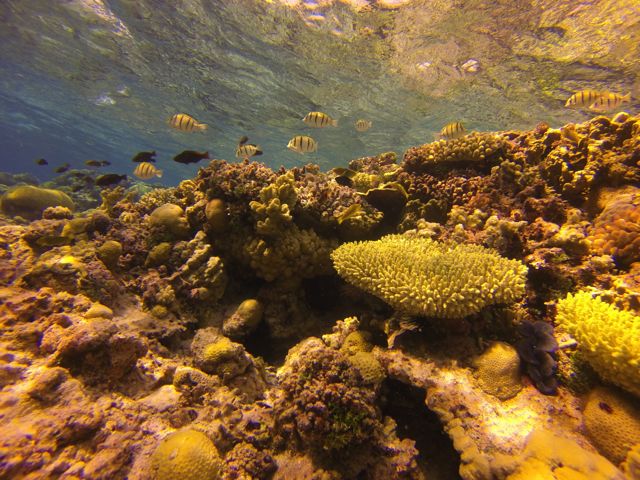
The remainder of our nearly two-week stay at remote Fulaga Island proved to be full of daily activities from dawn to dusk.  The long, narrow reef pass proved to be a wonderful snorkeling and SCUBA diving spot with opportunities to see big fish, sharks and amazing coral formations.  Timing the currents was important though as the tidal changes produced variations in water clarity and flow that would vary dramatically.  When the current was flowing out and emptying the lagoon, underwater visibility suffered.  During the peak of the incoming tide, clear ocean water brought better visibility and more big fish.  It also provided a magic carpet-like flying experience.  After taking our dinghies to the outside of the reef, we would drop in and be propelled like a group of flying super heros trough the pass while watching the amazing scenery go by beneath us. What fun!   Smaller passes between Fulaga’s inner and outer lagoons also provided interesting places to play in the current and see some beautiful topography. 

One day, we, long with other cruiser friends went ashore and walked to the village where we arranged for several young men and a woman to guide us through the dense jungle to the top of the island’s highest peak where we were treated to spectacular views of the area.  Along the way, we explored several caves that had, for centuries, been used by the islanders for shelter from storms and hostile invaders.  One cave even contained a pile of moss-covered, human skulls and bones dating back to the days of inter-tribal warfare and cannibalism.  It made us glad that we were visiting these people in 2013 and not 150 years ago when we might have ended up as the main course for a village evening meal.  In contrast to days past, when we returned to the village after our hike, our whole group was treated to a complimentary lunch of fish and fried rice served to us as while we sat on a woven mat in the shade of large tree.  These friendly and humble people were incredibly generous and quick to share anything that they had.

During one of our expeditions by dinghy, we visited a sandy beach that stretched for miles.  While exercising our legs, we scoured the beach for interesting shells.  Anne’s efforts rewarded her with a beautiful Chambered Nautilus shell in nearly perfect condition.  She was thrilled to add the rather rare, deep sea-dwelling specimen to her collection.

Our surroundings while anchored in the lagoon at Fulaga were idyllic but the weather was a little less so.  Located on the windward edge of the island group, Fulaga sees no protection from winds from the south and east.  While there, several days of strong winds and rain showers limited our outdoor activities.  We did take advantage though of all of the best days to get out and explore.  On one of the clear but windy afternoons, a group of us dinghied to the outside of the main reef pass to do a group SCUBA dive.  The plan was to dive in two shifts with half the group wrangling dinghies while the others dived and then trade duties for the second shift.  As the first group began gearing-up in their dinghies, while being buffeted by the strong winds and tossed about by the choppy seas, friends Ken and Beth drifted too close to a portion of the reef and were flipped over by a breaking wave.  They were both thrown into the water, just feet from there engine’s rotating propeller, and all of their gear, including two expensive underwater cameras, was scattered in the surf zone over the jagged coral reef.  Immediately realizing the seriousness of the situation, those of us nearby quickly leaped into action.  Rankin from “Gypsea Heart” maneuvered his dinghy as close as he dared and swooped Beth from the churning white water.  Mark, along with Derek from “Idyle Island” and Jon from “Evergreen” hurriedly swam though the breaking waves to Ken whose was doing his best to wrestle with the overturned dinghy that was being held in the worst possibly area by its anchor that had logged in the reef during the mishap.  While being continually  bounced off the jagged, coral bottom and pummeled by the incessant, breaking waves, the guys managed to right the dinghy and recover almost all of the lost gear.  While they worked, the girls carefully maneuvered the other dinghies out of harms way assisting where they could.  When the ordeal was finally over, the group had time to reflect on how dangerous the situation had been.  For Ken and Beth, it could have had life threatening consequences.  Needless to say, they were truly grateful for the assistance rendered.   Ken would later comment, while hosting a “thank you” happy hour aboard their yacht, “Eagle’s Wings”, that the village-like community of cruisers is comprised of  some of the most helpful, resourceful, and giving folks that he has ever known.  We certainly agree his sentiments.

Wednesday, August 7, 2013

Fulaga, Southern Lau, Fiji

Anne on lookout...entering Fulaga lagoon

Dozens of beautiful "cup cake" islets

Local fisherman on outrigger canoe

Mark in sulu

Anne with villagers

Kava 

Mark drinking kava

School yard rugby

Anne, Beth and Sandy with school girls

Locally made kava bowl with simple tools

Anne with new friend

Friendly school kids

Simple canoe

Simple canoe paddler
One of our goals for cruising in Fiji this season was to visit the remote southeastern portion of the archipelago known as the Lau Group.  Until recently, this area has been off limits to foreign visitors and the small islands that run in a chain from north to south offer a glimpse at simple village life and spectacular scenery both above and below the ocean’s surface.  Since the islands lie more than 100 miles to windward of Savusavu, the most eastern port at which vessels can officially clear into the country, many cruising boats, will no doubt, continue to skip this area as it usually requires considerable upwind  bashing into the southeast trade winds to get there.  So, while enjoying the scenery and fantatasic scuba diving at Viani Bay on the east side of Vanua Levu, we watched daily for a weather window that would allow us to sail southeast to the island of Fulaga in comfortable conditions.  When the window presented itself, we wasted no time in heading off on the overnight passage with friends on the catamaran “Gypsy Heart” following close behind.  Our plan worked fairly well despite having inconsistent winds that required motoring much of the way.  Twenty eight hours after leaving Viani Bay, we found ourselves off the narrow reef pass entrance into Fulaga’s lagoon.  Conditions could not have been better for our entrance with sunny skies, calm winds, and a slack current just prior to the morning’s high tide.  With Anne on the bow carefully watching the shallow coral borders of the narrow pass and Mark steering while tracking from waypoint to waypoint on our electronic navigation display, we made it safely into the lagoon and breathed a sigh of relief.  At that point, we had our first opportunity to take in the majestic scenery around us.  Inside the atoll’s outer reef lies the L shaped island of Fulaga and dozens of small cupcake or mushroom-shaped islets all covered with palm trees and vibrant green vegetation. Each islet is so beautifully decorated that they seemed the work of professional gardeners.  We then motored through the glassy water to a protected nook that served as an anchorage closest to the main village.  It was there that we rendezvoused with friends Sandy and Rankin from “Gypsy Heart”.  We were soon joined by Ken and Beth, from the yacht “Eagles Wings”, who had also made the passage down from the northwest.

 A short while later, our group took dinghies ashore carrying cameras and wrapped bundles of Yagona root that we would present to the village chief in what was to be our first experience in a traditional Sevusevu ceremony.  A significant aspect of Fijian culture is that the lands and waters of these islands belong to the villagers and that in order to be welcomed, and to make use of any of the above, an offering of Yagona root should be made.  The plant, from the pepper family, is ground by the villagers into a fine powder and mixed with water to make Kava, a grog like concoction that has both ceremonial and recreational importance.  Once ashore, the women in our group covered their arms and donned sulus (wrap around, shin-length skirts) in order to comply with the local “dress codes”.  The guys wore either long pants or sulus, as is the standard for men.  We were also advised that hats, backpacks and sunglasses were not to be worn in the village.  It seems that these customs date back to the days of intertribal warfare and the associated cannibalism.  Apparently, strangers who approached wearing anything that protected the heads and backs or anything that masked their eyes were greeted with the utmost suspicion.    Approaching the village, we were greeted by several friendly residents who happily escorted us to the home of the chief where we were properly introduced and asked to sit cross legged on a large woven mat surrounding a large wooden bowl filled with the dirty dish water-like Kava.  A number of villagers were in attendance including one of the school teachers.  Our arrival seemed to coincide with a normal end of the day Kava drinking session.  So, the chiefs right hand man welcomed us with Fijian prayers and, one by one, passed to us half coconut shells of the drink.  As tradition goes, the recipient is to clap once before drinking the liquid in one gulp and three times after.  Having tried Kava in Tonga, we knew to expect the numbing effect on our lips and tongue and that, due to the taste, gulping was indeed better than sipping.  We asked many questions and were told much about the villager’s life on the island.  Their village, with 80 inhabitants was the largest of three.  A supply ship comes once each month, weather permitting, to bring basic supplies to the villages.  Otherwise, they subsist on harvesting food from the sea and growing a few basic starchy crops.  During our two week stay at Fulaga, we would be overwhelmed by the friendliness of these people and their willingness to share any of their modest provisions.  After the ceremony, we took a walking tour of the village taking time to visit the school where young boys played rugby on a dirt courtyard and adorable, uniformed school girls followed us about with wide eyes and huge smiles.  It was clear that they have had little interaction with foreign visitors and we felt a bit like celebrities.  On our way back to our boats, we met many more of the villagers who stopped what they were doing, walked toward us offering their greeting of “Bula Bula” while extending their hands for a handshake.  That evening, while back on our boats in the scenic, peaceful anchorage, we had time to thoroughly reflect on the day’s experience and felt fortunate, humbled and rather honored to have had the kind of reception that we enjoyed that afternoon.

Wednesday, June 26, 2013

Savausavu, Namena Island and Viani Bay

Copra Shed Marina Docks and Moorings

Savusavu Town Market

Savusavu Market

Moored Yachts and Local Boaters


Adorable Kids

Anne with Fresh Produce

Yagona Root for Sevusevu (Kava Ceremonies)

Anne's Magnificent Carved Turtle Bowl

Savusavu Sunset

Viani Bay "School Bus"

Anne and Friend Alicia with Local Guide Jack Fisher
Towing Dinghies to Reef Dive Site

Grocery Run to Taveuni Island
Our ten days in Savusavu seemed to fly by.  While Mark attended to the never-ending “fix-it” list aboard “Blue Rodeo”.  Anne ferried loads of laundry ashore and explored the town with cruiser girlfriends getting familiar with store inventories and restocking our supply of fresh fruits and vegetables for the next leg of our trip.  One evening, friend Lisa, from the catamaran “Orcinius”, celebrated her 50th birthday at our favorite restaurant with the company of about a dozen of our cruising friends.  Also while there, a group of us got together with an ex-pat American, local cruising guru named “Curly” who is quite the character and looks a bit like a tropical Santa Claus with long white hair and beard to match.  His years of cruising Fiji’s waters make him an authority on the area and, for a small fee, shares the detailed information in the form of a seminar with each year’s crop of new arrivals.

While our Savusavu stay proved pleasant in most ways, one evening was filled with the kind of excitement and drama that we always hope to avoid.  While watching a DVD movie, snug and dry below decks in “Blue Rodeo” cabin, we noted the sounds and motion caused by a rain squall that had descended over the harbor.  Safely, so we thought, attached to a permanently anchored mooring block, we felt little concern as the wind gusts shrieked through our rigging and relief that we’d chosen not to go ashore by dinghy for dinner that night.  While our boat yawed back and forth and tugged at it’s mooring lines, we continued to enjoy our movie figuring that as was well until we felt a bit of a crunch and began heeling over a few degrees to starboard.  What was happening...had someone hit us?  Springing from the cabin into the darkness, howling winds and driving rain, we struggled to access the situation.  Blinded by the rain and light from the buildings ashore, Mark soon realized that we were no longer where we had been moored and, upon joining him topside, Anne exclaimed that she recognized a nearby boat as one that had been moored hundreds of yards downwind of us.  We had dragged our mooring through the crowded field of boats, narrowly missing several and ended up aground on a shoal near the harbor entrance.  At that time, there was no point wondering why but only time for immediate action to save “Blue Rodeo” from damage.  Mark quickly put out a call on the emergency VHF radio channel and, within minutes, a dozen of our fellow cruisers were speeding through the storm toward us to lend a hand.
For the next 30 minutes, a coordinated effort, hampered by the sever conditions, allowed us to maneuver free of the shoal and tie up to a vacant mooring that was spotted just three boat lengths to windward.  Too many words would be required to describe the combined efforts of all involved but everyone pitched-in to insure a successful outcome.  Wow...what and experience!  It was later determined that none of the mooring lines had failed but that the strength of the wind had simply caused us to drag our inadequately-sized mooring block.  We have always felt a bit uncomfortable using pre-established moorings, as opposed to anchoring, as one has to place a lot of faith in someone else’s equipment.  Unfortunately, due to small crowded harbors or areas with water too deep to anchor, moorings are sometimes the only choice.

Our next stop after leaving Savusavu was the small island of Namena about 20 miles to the sourhwest that is surrounded by an extensive barrier reef and lagoon.  We shared the anchorage there with friends Richard and Ali from the yacht “Vulcan Spirt”.  Our three days there included snorkeling near shore in an area where giant clams, nearly three feet across, are being nurtured and protected by a conservation group.  We also SCUBA dived two of the deep reef passes (openings) where we had a chance to see a splendid assortment of colorful soft corals and bigger fish including some inquisitive Grey and White Tip Reef sharks.  Before leaving, we made a mental note that we’d love to return to this place for more diving in the future.

From Namena, it was on to Viani Bay back on the east end of the island of Vanua Levu. 
The bay sits adjacent to the famous Rainbow Reef where, bordering the Somo Somo Strait, some of the world’s-best dive sites are located.  Viani Bay is also home to a gregarious local gentleman named Jack Fisher who lives with his family in a very modest home along it’s shore.  He is known for his hospitality and his service of escorting groups of divers out to the reef’s best dive sites.  Each day, he rows his aluminum skiff out to the anchored yachts and organizes trips to the reef for diving and snorkeling.  Since navigating the reef-strewn waters is challenging and anchoring in the best dive locations is nearly impossible due to currents and water depth, his service is invaluable.  His fee is just $10 Fijian (about $5.50 USD) per person.  Typically, one sailing yacht will offer to serve as “mother ship”, with Jack at the helm, taking as many divers as possible and towing multiple dinghies loaded with SCUBA equipment. Over the course of the two weeks we spent there, we volunteered “Blue Rodeo” three times as did many of our friends with their vessels.  In the short period of time, we did nearly a dozen dives and were rewarded with splendid sights along the reef’s walls.  Due to the strait’s strong currents that change directions several times daily, proper timing is important in order to see the area’s soft corals in all of their splendor.  When the currents increase the flow of the nutrient-rich water, the colorful soft corals inflate their branches to gather the microscopic food particles as they pass buy.  At times, the coral coverings of the reef’s sides are so complete that two of the sites are known among the international diving community as the “Purple Wall” and “White Wall”.  Diving among these incredible formations proved to be a 3-dimensional treat for the senses.

While our entire season could have easily be spent diving the reefs near Viani Bay,  our goal had always been to sail further southeast into the remote and relatively primitive Lau Group of Fiji’s islands.  The area has, until recently, been off-limits to foreign visitors so, going there was an opportunity to experience unspoiled Fijian village life and see sights that few outsiders have ever seen.  So, when the weather cooperated to allow us to make the 180 mile trip without bashing into the normal prevailing trade winds, we jumped at the chance.  After an early morning departure, we were soon making way toward the southernmost island of Fulaga in hopes of arriving in time to enter it’s lagoon’s narrow reef pass with slack currents during the next morning’s high tide.  Once again, new adventure awaited us.

Tuesday, June 18, 2013

New Zealand to Fiji


South Minerva Reef Lobsters


Anne with her Yellowfin Tuna

Every fall, the small port of Opua, in New Zealand’s Bay of Islands, is a popular “jumping-off” point for vessels heading north to the tropical islands.  When we sailed “Blue Rodeo” there during the last week in April, we were immediately impressed by the harbor’s spirit and energy level.  New Zealand’s Island Cruising Association was just completing a week of activities and seminars for participants in a rally that it was leading to Tonga and various other island destinations and boats were arriving from all points.  We were pleased to see many familiar faces of cruisers that we met during our Pacific crossing last year.  Within no time, we were caught up in the excitement (and hard work) of preparing ourselves and our boat for the upcoming passage.  Each day was spent finishing boat projects, studying weather forecasts, and provisioning.  Evenings often included socializing and dinner with sailing friends, new and old, at the harbor’s cruising club.  Mark and friend Craig from the catamaran “Goto Go” have May birthdays, just one day apart, so our huge group enjoyed a combined birthday celebration, complete with chocolate caramel cake there one evening.

The passage from New Zealand to Savusavu, Fiji requires an ocean crossing of approximately 1150 miles.  An alternate crossing can include a stop at the Minerva Reefs along the way.  Due to the potential for nasty weather in the area, all sailors take this trip quite seriously.  Early winter cold fronts and low pressure systems can rapidly sweep across the waters just north of New Zealand producing high winds and large seas.  Further north, with the tropical cyclone season just ending, late season low pressure systems can still pack a serious wallop.  Most cruisers vividly remember the infamous “Queens Birthday Storm” of June 1994 where the unpredicted formation of a deep and rapidly expanding low pressure system along this route produced 50 to 60 knot winds and 40 to 50 foot seas.  Many cruising boats found themselves in a life or death struggle in the severe conditions.  In the end, 8 boats were lost or abandoned and, tragically, 3 lives were lost despite New Zealand’s largest-ever search and rescue effort.  So, several times daily while in Opua, we would analyze weather forecasts from all of the available sources, share it with other cruisers and play the “When Do You Think We Should Go Game”.  The term “analysis paralysis” if often used to describe the feeling but eventually, weather windows present themselves and decisions to set sail are made. 

On May 8th we completed the customs and immigration clearing out process, cast off our dock lines, and pointed “Blue Rodeo’s” bow towards Fiji.  A forecast for westerly winds of up to about 20 knots proved accurate and soon, we were flying along on a beam reach rapidly putting miles under our keel.  During the first few days of the passage, sea conditions were moderate, with swell and wind chop of less than 6 feet, but we both struggled to reacquire our “sea legs”.  Our mostly land based life during the last 6 month had left us a bit unaccustomed to all of the motion.  Even though using medication for motion sickness,  Anne fought to control her nausea and Mark, who normally can handle just about anything, even felt considerably less than perfect.  Despite the uncomfortable conditions, we were pleased by our progress, having sailed 210 miles in the first 24 hrs and almost 400 in the first 48.  We were rapidly sailing away from the cool air and water around New Zealand and knew that soon, we would be able to shed our layers of insulation and be back to standing night watches in T-shirts and board shorts. 
When we departed, we anticipated the need to sail west of a straight line to Fiji in order to avoid a slow moving, low pressure system that was likely to form in our path.  We stuck with that plan but, on day 3, found the weather deteriorating and experienced frequent, heavy rain squalls, strong winds and confused seas.  Each morning we would use our satellite  phone and it’s email capability to obtain weather updates and reassess our strategy.  As we soldiered on in uncomfortable conditions with the boat healing at 15-20 degrees and lurching about unpredictably, we were happy that Anne had pre-cooked meals for the passage and dinner preparation was as simple as throwing a bowl in the microwave oven for a minute or two.  Simple that is, if you can imagine trying to maintain your balance using one hand to hold on while bowls, utensils and hot food made every attempt to escape your grasp and fly across the galley. 

With less than 500 miles remaining to Fiji, but receiving a forecast for unfavorable winds for the remainder of the passage, we made the decision to turn east and sail 230 miles to South Minerva Reef.  Weather forecasts indicated that we might luck out and be able to stay there for a week or more and enjoy nearly perfect conditions for snorkeling and diving.  With that decision made, “Blue Rodeo’s” course was altered, sails re-trimmed to wing on wing (main sail to one side and jib poled-out to the other) and began surfing the, now following seas, toward Minerva.  The next 24 hours provided much more comfortable sailing conditions and soon we were navigating through the reef pass into the lagoon at South Minerva where we found two other boats already at anchor. 

The next 6 days were spent in this truly unique place, hundreds of miles from the nearest land but protected by a circling reef.  On our trip from Tonga to New Zealand last November, we had stopped briefly at North Minerva Reef but were chased out by an approaching storm. This time, the weather was more cooperative and we were able to spend 9 days anchored in the protection of the two reefs, snorkeling in the crystal clear water and sharing a lobster feast with other cruising friends (courtesy of Alfredo, from the vessel “On Verra”, who had captured 6 large lobster among the caverns and crashing waves on the outer reef).  While the weather was good overall, our small group of cruisers experienced one hell of a storm one night with thunder and lightening to rival anything we had ever seen.  Lightening bolts struck nearby, thunder boomed and wind gusts shrieked through our rigging.  In most conditions, South Minerva’s reef offers adequate protection from ocean swells but this storm turned the lagoon into a washing machine-like basin of rough water.  Several boats nearby us had anchors break free from the sandy bottom sending them dragging toward the jagged coral reef.  The violent motion caused another’s anchor chain to jump from the teeth of its windlass sending all of it out, only to be stopped when a shackle at the very end jammed in the stainless steel deck pipe.  Luck was on their side as, had it parted completely, they would have surely ended up on the reef.  Fortunately, the storm’s fury passed in about 2 hours and we were able to sleep well for the remainder of the night.  It was just another example how this cruising life isn’t always about sipping cocktails while watching the sun set over another tropical island. 

After a few days, we began to see a forecast for suitable weather for the remainder of our passage to Fiji and set out one morning on what would be an easy and enjoyable three-day sail to Savusavu.  On day two, Anne's fishing efforts produced a hook-up with a nice Yellowfin Tuna.  The fish gave her quite a fight but, while Mark handled the sailing, she managed to reel it in.  Thirty minutes later, several meals-worth of delicious tuna fillets were packed-away in our freezer.

 Moderate winds from the southeast pushed us comfortably along until the early hours of the last morning when, just 35 miles from our destination, the wind quit completely.  At that point, we fired up “Blue Rodeo’s” trusty diesel engine and adjusted our speed so as to arrive in Savusavu at dawn.  A short while later, we were securely tied to a mooring at the Copra Shed Marina, just a short distance from the small town.  Once again, we felt the enormous satisfaction, and some relief, at having successfully and safely completed another long ocean passage.  As evidenced by the lush greenery all around, the fragrant smells and the air thick with moisture, we were clearly back in the tropics.

Over the next few hours we did our best to make “Blue Rodeo” ship shape and completed the clearing-in process with government officials that were shuttled to the boat by marina staff.  We found all of these folks to be exceptionally friendly and welcoming and, despite getting writers cramp from filling out form after form,  found the whole process rather painless and somewhat entertaining.  Wow...we were in Fiji!!

Thursday, June 6, 2013

New Zealand 2012-2013


As we write this, we are sitting in “Blue Rodeo’s” cockpit on a tranquil morning moored off the small town of Savusavu, Fiji.  We are back in the full-time cruising and adventuring mode after 6 months in New Zealand.  Our “off season”  in new Zealand seemed to fly by as our time was consumed by a two-month trip home to the States to visit family and friends and, upon our return, a seemingly endless stream of boat projects that required all of Mark’s focus and energy.  Sadly, our plans to do some extensive land travel, camping and hiking had to be postponed until next season when, after six months in Fiji, we’ll return to New Zealand where we’ll again base “Blue Rodeo” for the Austral summer (tropical cyclone season).

Despite the hard work making improvements to our boat, we greatly enjoyed our time in New Zealand and see why many cruisers return year after year.  After making landfall in Opua, in the North Island’s lovely “Bay of Islands”,  we sailed about a hundred miles south to a bay and river mouth leading 8 miles inland to the small city of Whangarie where the charming Town Basin Marina is located, right in the heart of the city.  Navigation from the open ocean up the river is straight forward via a well buoyed channel but, for vessels like ours with a fairly deep draft, must be made at high tide to avoid numerous shallow areas.  Due to our arrival a bit ahead of schedule and our impatience to reach our destination, we found ourselves tip-toeing along through some of the river’s shallow sections with just inches of water between our keel and the soft mud bottom.  At one point as the river took a lazy bend to the right, we found ourselves slowed to a stop as we touched bottom.  We were in the center of the marked channel but, as we would find out later, transit of that area required hugging the southern shore just a few boat widths from the river bank.  The incident was without any real drama as we knew the tide was still rising and, with the application of some serious reverse thrust, we floated free and were able to proceed via a different line.  An hour later, we were securely tied up in our marina slip and breathing sighs of relief.

We found Whangarei to be a perfect place to base “Blue Rodeo”.  The town has all of the shopping and dining venues that one could want and is a hub for the North Island’s marine industry with numerous boat yards, chandleries and resources all within a small radius.  Added bonuses were a beautiful swimming pool complex across the street from the marina and a system of hiking trails in the nearby forest that provided a pleasant place to exercise and attempt to burn off the calories consumed in the towns many interesting eateries.

Since boats are always a work in progress, “Blue Rodeo” being no exception, while in Whangarei, we took the opportunity to take advantage of the convenient resources and make some improvements to the vessel.  The biggest of which was the modification of our cockpit’s fiberglass top (dodger) to allow the addition of one half inch thick, heat formed, clear acrylic window panels to replace to original, semi-rigid, removable ones.  While sailing through rough weather from Tonga to New Zealand, we had one of the forward panels broken out by wave impact and sought a solution to the problem of ever having that happen again.  We were so very fortunate to connect with a local craftsman named Steve Eichler who was heartily recommended by friends Ken and Beth from the sailing vessel “Eagle’s Wings”.  The project was quite involved requiring the fiberglass fabrication of window frames and bonding flanges and a mold from which the acrylic panels were produced.  The end result was a work of art and a valuable upgrade to our boat.  Smaller projects, too numerous to mention, kept Mark busy from sunup to sundown and “Blue Rodeo” in a nearly constant, construction zone state of disarray.  With the interior often so cluttered with boxes of tools and boat parts, leaving nearly nowhere to even sit down, Anne busied herself with daily hikes with girlfriends and frequent provisioning recon trips to Whangarei’s many markets.   As the weeks passed, evening time was taken to socialize with our many cruising friends who had chosen to summer-over in the area but our hopes of land touring evaporated.  On a positive note though, we managed to accomplish most of the big items on our project list and expect minimal boat work next year which will free us up for seeing more of New Zealand’s natural beauty.

As our May 1st estimated departure date approached, we continued to scramble to get everything done.  Mark’s 43 item “to do” list was whittled down, even though he continued to add more items daily.  Finally, with most chores done, we left Whangarei and headed back up the coast to Opua, our jumping-off point for Fiji, stopping to enjoy two nights at a lovely anchorage along the way.  We both remarked that it felt so wonderful to be away from the dock and back in open water.  Although many people use their boats as waterfront “condos”, being back underway reminded us of how much we cherish the experience of really using our fine vessel as the designer intended.

Tuesday, December 4, 2012

Minerva Reef to New Zealand

With an early-season, tropical low and its associated strong wind and rough seas forecast for the area around Minerva reef, we raised anchor after a stay of just 2 nights and began our 800 mile passage to New Zealand.  Ironically, on the morning of our departure, the sun was shinning brightly though the cloudless sky, the winds were completely calm and the seas flat and glassy.  It was a perfect day for a motorboat ride.  Unfortunately, our motorboat ride nearly ended as quickly as it began when, after motoring the 2 miles from our anchorage across the lagoon to the reef pass leading to the open ocean, we noticed that our engine’s water temperature had risen to well above normal.  After a quick check to verify that cooling water was still coming from “Blue Rodeo’s” exhaust (it was normal) Mark shut down the engine and hurried below to investigate the problem,  Fortunately, with the calm conditions, we were in an area that allowed us to drift about, free of any hazards while Mark worked below.  Once our engine compartment was opened, it took but a moment for Mark to discover and fix the problem.  Earlier that morning, while trying to solve a slipping alternator belt problem, Mark had removed a common belt that also drove the engine’s internal, fresh water pump.  Without the belt, water was not circulating through the engine, leading to the rise in temperature.  Mark briefly kicked himself for making a rather “bone-headed” mistake and reinstalled the belt restoring normal operation of the pump.  In order to solve the slipping problem caused by the loads imposed by the alternator, he simply disabled it by removing its field wire allowing it to rotate with little resistance.  At that point, he searched through our ample supply of V-belts and was disappointed to find that there were no more spares of the correct size to replace the cracked and brittle ones in use.  As we resumed motoring out of the lagoon and pointed our bow toward New Zealand, we were resolved to make-do with what we had until we received a radio call for friends Ed and Fran on the vessel “Aka” who had left the anchorage a short time after us.  They had heard our communication with another yacht explaining our reason for stopping and were quick to offer any spare belts they had aboard.  After getting the dimensions of the belt we needed, Ed searched through his spares finding several that would work for us.  We gladly accepted his offer to make an “at-sea” transfer and slowed “Blue Rodeo” to allow “Aka” to catch up.  With Fran at the bow of their boat and the belts suspended from a boat pole, the transfer went without a hitch.  After offering a sincere “thank you”, we accelerated back to normal speed feeling more comfortable that we had a spare or two if needed.  This was a good example of nearly daily occurrences within the cruising community when parts, assistance and advise are shared with others.  How fortunate we are to among so many generous and caring folks!

For the next 20, windless hours we motored peacefully, enjoying the pleasant and comfortable conditions.  It was during this time that we began so see an amazing sight.  Scattered about the surface of the sea were meandering streams of floating rocks.  Pumice rocks, ranging in size from tiny pebbles to some nearly the size of basket balls, had been ejected from an undersea volcano hundreds of miles from us and were now being pushed by the winds and currents over a huge area of the South Pacific.  While quite interesting, the sight of the pumice made us worry about ingesting some of the material into our water intakes and think how frightening it would be to be sailing near the volcano when the eruption occurred.

The wind forecast for the next five days showed south-easterlies rising in strength to around 30 knots before shifting to the south.  With that in mind, when the winds began to build, we shut down our engine and trimmed our sails to sail as close to the wind as possible, staying close to the rhumb line to our destination of Opua on New Zealand’s North Island.  With winds increasing in strength, “Blue Rodeo” was soon flying right along, occasionally crashing into the troughs between swells or partially burying her bow into the front of oncoming waves.  Our pleasant ride of the first day had been replaced by a bucking bronco, blue rodeo sort of ride.  Soon, moving about the boat required care and effort and chores and meal preparation became a physical challenge.  Fortunately, Anne had pre-cooked enough dinners for the passage and we were able to zap them in our microwave oven with minimal effort and mess. Like with any multi-day passage, we settled-in to a watch schedule, watching for traffic, trimming sails and navigating while the off-watch person slept. 

Before we even reached the mid-point of the passage, the winds had increased to strengths well above forecast, reaching full gale force.  As the winds increased and the associated seas grew, we reduced our sail area by reefing our main sail to the triple-reef point and rolling our jib most of the way up.  While doing this one morning, one of our jib sheets (control lines) disconnected from the sail’s clew ring when the snap shackle at its end opened accidentally.  With the winds shrieking in excess of 40 knots and the sail flogging badly, the other sheet’s shackle also disconnected leaving Mark no choice but to go forward from the safety of the cockpit to reattach them.  After several minutes of foredeck gymnastics, including standing atop our wave-washed, stainless steel bow pulpit, Mark was able to reattach the sheets and, with Anne’s help, properly reef the sail.

Each morning and afternoon, we listened on our SSB radio to other boats enroute to New Zealand report their positions and sea conditions hoping for some insight as to what conditions we might expect up ahead.  As we continued to sail close-hauled, pointing as near to the wind as possible, our ride remained uncomfortable.  After months of downwind sailing, this heavy-weather, sailing to windward stuff was beating us up.  Also, despite Marks efforts to damn-up small openings where water on deck can find its way into the boat, we experienced annoying leaks that kept us scurrying about, sopping up small puddles with towels.  At one point, as we pounded ahead, several of the wedges used to position our aluminum mast in the collar through the deck came loose causing the mast to pump and flex with each plunge into the wave troughs.  This created a cascade of water down the mast and into our sleeping cabin until Mark was able to make a temporary repair and stop-up the leaks. During this time, wave impact also broke out our cockpit’s forward, port-side dodger window allowing spray and occasional waves to enter the cockpit unimpeded.  The dodger’s window had been compromised by a few age-related cracks and failing, glued seams and was no match for the wave impact.  From that point on, during the stormy conditions, we had to keep our companionway boarded-up and closed to minimize more water intrusion.  Unfortunately, with our constant heal angle, water would still find its way in and drip from the ceiling onto our galley stove, countertop and floor.  Before conditions improved, we had resorted to using shower curtains to catch the drips and had soaked nearly every towel we had aboard.  It was during this time that Anne looked at Mark and asked, “Are you liking this?”.  To her relief, Mark answered no and that driving around a countryside in an RV was sounding really good to him at that point.  We guess that misery really does love company and we could, a least still have a chuckle over our situation. 

Despite the rough conditions, “Blue Rodeo” continued to prove her worth and seaworthiness and continued swiftly toward our destination.  Less capable boats that had left at about the same time we did were struggling and forced to head further west to make progress.  In the end, we would arrive at our destination several days ahead of these boats showing, once again how fortunate we are to have the boat we do.  Even though our passage was less than comfortable, those to the north of us were experiencing even worse conditions.  We had about 36-48 hours of winds in excess of 30 knots with a recorded gust of 45.1 knots.  Our estimated sea heights remained less than 20 feet.  The real drama took place a few hundred miles north where a 40 foot sailboat, with a couple from New Zealand aboard, was knocked down (possibly rolled) by 30 foot waves and winds over 50 knots.  They were injured during the incident and the boat was damaged leading to a “mayday” call for help.  Various agencies, including the New Zealand Air Force rallied to their aide and one small cruising boat bravely bashed 30 miles back into the storm to render assistance.  In the end, a rescue was accomplished by a container ship that had been diverted to help but Bruce and Marcel, aboard the boat “Adventure Bound” that had stood by in case needed, had to endure many extra days at sea in awful weather conditions once the stricken couple was safe aboard the large ship.  Ten days later, when “Adventure Bound” finally reached Opua, New Zealand, we were on hand to give them the hero’s welcome they deserved and prevent them with gifts donated by the cruising community to commend them for their selfless actions.  While we forged ahead listening to the saga of “Adventure Bound” returning to offer help, we talked about how, if we’d been the closest boat, would have certainly done the same.  That is just what mariners do. 

Eventually, the nasty weather conditions eased and, as the coast of New Zealand came into sight, winds dropped to a zephyr and we started our motor for the final few miles past Cape Brett and into the beautiful Bay of Islands.  What thrill it was to return!  Mark had been envisioning this for several years since his arrival with friend Steve aboard his boat “Elusive”.  During those last few miles, we had the opportunity to tidy-up “Blue Rodeo” and sort through the assorted food items that were likely to be confiscated by New Zealand Customs officials upon our arrival.  Anne hurriedly baked our remaining apples into fruit and oat bars and we fed the fish with a few veggies.  Thinking that nuts would be confiscated, Mark ate nearly half a jar of his favorite roasted almonds that had recently been found in one of our lockers, only to later learn that the nuts were on the “Allowed” list.  He still remembers the resulting stomach ache.

Our passage concluded by tying up at the custom’s dock after 5 days and 4 hours of sailing from Minerva Reef.  We felt a tremendous sense of accomplishment and some relief in being back in “civilization” and the land of plentiful boat parts and supplies.  The next several days were filled with nearly nonstop socializing and joyful reunions as sailing friends trickled-in.  Everyone had stories to tell, as did many boats that looked worse for the wear with shredded sails and torn canvas.  For the next two weeks, we began a series of boat repairs and improvements, bought a car, and proceeded to indulge ourselves nightly with burgers, fish and chips and curried specialties while sharing beer and wine with many friends at the “Cruising Club” headquarters overlooking Opua’s beautiful bay.   Soon it would be time to sail “Blue Rodeo” down the coast to the town of Whangarei where we’d made arrangements for a marina slip to leave her during our trip home to the States and some land touring on our return.

It will, no doubt, take months for the scope of our South Pacific sailing adventure to sink in.  We are loving this life and already looking forward to next season’s travel to Fiji, Vanuatu and New Caledonia.  

Monday, December 3, 2012

Nuku'alofa and Minerva Reef

Since the beginning of the time when sailors first began to cross bodies of water, away from the shelter of land, voyages were planned with regard to the weather’s current conditions and seasonal patterns.  As modern sailors, we are no different.  So, when making plans to sail south from Neiafu, Tonga to Tongatapu and the country’s capital city of Nuku’alofa, we took into account a forecast that indicated a hasty departure was in order.  By leaving soon, we’d likely have good winds for a swift, overnight passage but would have to forgo stopping at some of the islands we’d missed in the Ha’apai area during our first visit.  Delaying our departure would mean either motoring in calm conditions or waiting for another favorable window.

Our trip to Nuku’alofa worked out pretty much as planned with the exception of an approaching area of high winds and rain that enveloped us during the last few hours of our sail.  As we wound our way between the reefs and through the channels leading to the anchorage off “Big Mama’s” resort on the island of Pangaimotu near Nuku’alofa’s harbor, we began to experience winds in excess of 30 knots and were fortunate to get our anchor set just as we began to be pelted by heavy rain.  During the next stormy hour, visibility dropped to just a few hundred feet and several boats in the anchorage began to drag their anchors requiring them to move and reset.  Before long, the worst of the weather had passed and, by late afternoon, a few rays of sunshine were even illuminating the area.

Since beginning our South Pacific trip, Mark had looked forward to returning to this place with Anne aboard “Blue Rodeo”.  Four years ago, he had flown to Tonga and joined his good friend Steve aboard his boat “Ellusive”, anchored off Pangaimotu and the two then sailed the boat to New Zealand.  At that time, Mark and Anne were still boat shopping and dreaming of cruising and arriving here aboard “Blue Rodeo” was truly a “dream come true”. 

While at Pangaimotu, we had to opportunity to reconnect with many cruising friends and  join in the festivities at “Big Mama’s” one evening when she put on an extravagant anniversary dinner complete with a complimentary buffet including the usual Tongan specialties and several roast pigs.  A band was even brought to the island for the occasion and we partied and danced in the sand until well past our normal bed-times.  Places we’ve visited this year are often described as “cruiser-friendly” but few live up to the charm and genuine hospitality displayed at “Big Mama’s”.

With apprehension about the long and often stormy passage to New Zealand weighing heavily on everyone’s minds, daily analysis and discussions of “weather windows” was the common topic among cruisers over the next several days.  Our hope was to sail the 280 miles from Nuku’alofa to Minerva Reef where we’d hoped to spend a week or more before continuing another 800 miles to New Zealand.  It was based on that plan that we set sail from Pangaimotu, bound for Minerva Reef, with fresh breezes pushing us steadily along for the first portion of the trip.  Not far from the islands that make up Tongatapu, Anne’s good fishing luck continued when she successfully landed a thirty-plus pound, Big-Eyed Tuna.  We would later dine on delicious, seared tuna steaks served with a Wasabi and rice wine vinegar sauce.   During the next two days, winds shifted to a direction causing us to tack back and forth to make progress toward Minerva and seas grew quite choppy and confused leaving us with a rather uncomfortable ride.  Eventually, as expected, the winds lightened forcing us to start our motor and motorsail the remaining few miles to our destination.  We had hoped to reach the narrow pass entrance through the reef into Minerva’s lagoon during daylight hours but it wasn’t until after midnight that we arrived.  Aided by bright moonlight and armed with accurate GPS waypoints and his knowledge from having been to Minerva before, Mark felt comfortable entering after dark and proceeding the two miles across the lagoon to the southeast side where six other cruising boats were anchored.  It was a beautiful sight to see starlight reflected on the sea around us and the twinkle of the boats’ anchor lights beckoning from a distance.    Before long, we were anchored and settling into our bed for a sound and peaceful night’s sleep.  With the reef encircling us and calm, flat water around us, we felt as though we were anchored in a lake in the middle of the ocean.

We spent the next day snorkeling in the crystal-clear water inside Minerva’s lagoon seeing rays, eels and huge lobster and surprising several sharks sleeping in caves along the reef’s undercut edges.  The calm conditions and truly spectacular water color and clarity provided a visual feast.  After our snorkeling excursion and while driving our speeding dinghy from a standing position to better see the shallow areas, Mark had to sit down to quell a momentary feeling of vertigo caused by racing over the glassy- smooth water and the incredible detail of the bottom topography rushing by underneath us.  He said he felt as though we had become airborne and had no idea how high we were above the surface.  It was quite a surreal sensation.

Our plans to enjoy Minerva reef for a few days longer changed that night when we hosted dinner aboard “Blue Rodeo” and we joined by friends John and Lisa from the yacht “Orcinius” and Mike and Karen from “Chapter Two”.  Lisa brought along her IPad with a picture of the latest weather forecast for our area that she had downloaded via satellite phone and computer.  Our group intently studied the wind forecast map showing a tropical low pressure area (precursor to a cyclone or hurricane) forming within days and forecast to head our way.  It looked as though the only prudent thing to do would be to leave for New Zealand sooner than planned and put as many miles between us and the storm as possible.  So, with that in mind, we shared a delicious meal of Anne’s chicken curry while engaging in light-hearted conversation.  Inside each of our minds though was the beginning of the mental preparation necessary for leaving Minerva and the passage ahead.  Such is the life that we have now grown accustomed to...good times balanced with a nearly-constant need to assess the environment around us to insure our safety and security.