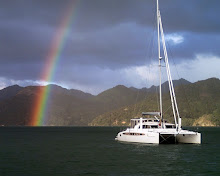
Leaving the Island of Hiva Oa, we set sail for the small island of Fatu
Hiva, about 45 miles to the southeast. Fortunately, the wind direction
and sea conditions were cooperative and we made the crossing in good time
on a single tack (without zigzagging back and forth to make windward
progress). We approached our intended destination with eager anticipation
knowing that it is regarded by many as the most beautiful anchorage in the
world. Hana Vave, or the Bay of Virgins as it is now called, is a small
bay on the island’s northwest side at the mouth of a narrow valley. A
village with about 600 residents sits near the water’s edge surrounded by
incredibly beautiful, jungle-covered rocky cliffs and spires. These
dramatic rock formations inspired the bay’s original name of the Bay of
Phalluses. Apparently, that name didn’t meet with the approval of the
Catholic missionaries upon their arrival years later so, by a changing a
vowel in the original French word, phalluses became virgins.
We approached the bay when the late afternoon light was illuminating the
rock formations and lush green hillsides with such intensity that the
colors and shapes were a feast for our eyes. We hurriedly took photo
after photo as we made preparation to anchor knowing that it was unlikely
that any would completely capture the majesty of this place. The
anchorage there is deep, limited in size and has, in many places, a rocky
bottom. We slowly meandered through the gaggle of already-anchored boats
looking for a spot where we might drop “Blue Rodeo’s” anchor to a sandy
bottom at a reasonable depth. We settled for an area that was 90 feet
deep (we’d prefer to anchor in 25 to 30 feet of water) and lowered our
anchor and almost all of its 350 feet of chain. Reports had mentioned
that wind gusts of 60 knots can funnel down the narrow valley and blow
anchored boats out to sea so we made sure our anchor was well set before
relaxing.
While we were still underway to the island, we had spoken to friends from
the vessel “The Rose” who invited us to join them and a number of other
cruisers for a dinner ashore that night at the home of a local family. It
turned out to be a lovely evening with an opportunity to sample lots of
typical Marquesan cuisine and get to know more interesting cruisers.
Since Fatu Hiva is the most windward of the islands in the Marquesas, it
is often the first stop for cruisers coming from Panama or the Galapagos,
even though it is technically not a port of entry. Several groups at
dinner that night were from Europe and had come straight to the island.
During the next few days that we spent in the Bay of Virgins, several
others would arrive with the tell-tale coating of algae and gooseneck
barnacles along their boat’s waterline as a result of many days at sea.
The next day was spent in the company of friends from the boats
“Charisma”, “The Rose”, and “Island Bound” exploring the small village and
getting to know some of its residents. There is just one tiny market but,
with a bit a asking around, we soon connected with several of the
friendly residents who provided us with fresh fruit to restock our onboard
supplies. Most of our exploratory walk that day took us to the backyard
sheds of local craftspeople that produced fine wood carvings and painted
art works on “Tapa” cloth made from pounding water-soaked bark into
paper-like sheets. We couldn’t help but buy a small, carved, rosewood
“Tiki” and a “Tapa” print to commemorate our visit. By the way, the
Marquesas are considered to be a birthplace of the art of tattooing and,
even though the traditional art form nearly died-out, a number of current
artists are practicing it and most locals we encounter have their bodies
decorated. Often, visiting cruisers are so moved by the experience of
crossing an ocean to visit these exotic islands that they choose the get a
Marquesan tattoo to commemorate the experience. While Anne is opposed to
the idea, Mark admits that he can’t help but have some interest in some
small, traditional tattoo. He has though, opted not to get one, motivated
mostly by the fact that his hairy, freckle-covered skin that continues to
wrinkly before his eyes is probably not the best “canvas” to display a
Marquesasn work of art, no matter how beautiful it might be.
The next day was spent hiking to a stunningly beautiful grotto in the
hills above the village that features a 200 foot waterfall and freshwater
pool at its base. A group of about 8 of us make the trek up through the
steamy jungle to reach it and were rewarded by magnificent scenery along
the way and a refreshing dip in the pool at the falls. That evening
turned out to be the high point of our visit with another feast ashore put
on by a delightful and friendly woman named Kati, whom we had met during
our visits to the wood carvers. Pat, from “The Rose”, used her better
French communication skills to arrange a cooking lesson for anyone that
wanted to come early to watch how the traditional meal of poisson cru,
beadfruit, papaya salad, baked bananas, and chicken was prepared. The
event coincided with the celebration of Kati’s 7 years old granddaughter’s
birthday so our fortunate group of cruisers became part of the huge party
that concluded with after-dinner birthday cake, guitar and ukulele music
and singing and dancing from the many neighborhood children. We took
dozens of photos and some short video clips but, sadly, none will do
justice to the warmth, camaraderie and joy that we experienced that night.
We have to trust our memories to accurately record forever the magic of
that evening.
The next morning, when Anne climbed out into “Blue Rodeo’s” cockpit, she
squealed with excitement at the sight of a familiar sailboat entering the
bay. Our friends Larry and Karen, whom we spent good times with during
our first season in Mexico and had not seen for many months, were arriving
after a 22 day passage from the Galapagos. Since many of our cruising
friends in the anchorage were planning to go ashore in less than an hour
for the town’s Sunday church service, we quickly greeted our arriving
friends and offered to take them ashore in our dinghy as soon as they
could get settled. We had heard from others that the Catholic church
service, spoken in Marquesan and featuring lovely music and choir singing,
was very special and not to be missed. We were not disappointed as the
beautiful, pitch-perfect voices of the children’s choir left us all very
moved. We also couldn’t help but be entertained by the warm interaction
of the villagers.
That Sunday concluded with a delicious dinner aboard Larry and Karen’s
boat “Phanta Rei” with their crew Katie and Kent and friends from “Island
Bound” Bill and Kat. Before dinner, we all shared information about where
we planned to go next and our probable itinerary for the next few months.
While part of the fun of cruising is getting to know new people wherever
you travel, connecting with those that you have already met in exotic
parts of the world is extra special.
Our evening aboard “Phanta Rei” ended rather suddenly when some of the
anchorage’s notorious wind gusts began to blow through the bay and we felt
it best to head back to our boat to make sure that all was well. Upon
return to “Blue Rodeo”, we were disappointed to see that one of Mark’s
Patagonia Hawaiian shirts and his favorite pair of board shorts, that were
left pinned and drying on our clothesline, had been blown off into the
darkness of the night. Oh well, it was another lesson learned about
leaving anything unsecured while we are off the boat. It certainly could
have been worse as our entire floating home might have been blown out to
sea
Wednesday, May 9, 2012
Tuesday, May 8, 2012
Paumau Bay
Our circumnavigation of the island of Hiva Oa continued with an overnight
stop at picturesque Hanaiapa Bay followed by another day sail to Puamau
Bay. Beautiful Puamau features a number of immaculately kept homes, a
small, open-air restaurant and some of the best archeological ruins in all
of Polynesia. It is accessible by road from the main town of Atuana so
the locals are accustomed to visiting tourists.
Our trip ashore for a walkabout and visit to the archeological site began
with navigating our outboard motor- powered dinghy through fairly large
surf to land on a narrow, sandy beach. Mark patiently studied the pattern
and frequency of the larger sets of breaking wave and managed to get us to
the beach without any drama. Friends Bob and Ann from the boat “Charisma”
rowed their dinghy ashore and also landed without incident. As we all
dried our feet and changed into our hiking shoes, we couldn’t help but be
overwhelmed by the spectacular scenic beauty around us. Fortunately, the
local residents must appreciate it as well as evidenced by how clean and
pristine everything seemed to be. The yards around the rather simple
homes well all carefully manicured making us feel as though we were in a
park.
Our trek to the archeological site began by passing the small restaurant
were a sign pointed us in the right direction and indicated that there was
as $3.00 fee per person to visit it. We happily paid the fee and began
the 20 minute walk up a steep, paved road to the site. All along the way,
we were amazed by the amount and variety of fruit literally falling from
the trees around us. Every few steps we’d stop to examine some example of
exotic tropical fruit. The stops in the shade of the many trees gave us a
chance to cool off a bit as we were all drenched with sweat and suffering
from the heat and humidity.
After following the steeply climbing road as it made its way up the lush,
jungle-covered hillside we reached our destination where we found an
impressive display of carved stone “Tikis”, some resembling humans and
some more animal-like. In addition to the Tikis, the area featured rather
elaborate stone walls and platforms. We examined the carvings with awe
and felt so fortunate to be alone at this very special place with just the
company of our two friends. After taking dozens of photos we followed the
road back to the beach where we were chagrined to see that, while we were
away, the surf had gotten even larger. Before attempting to head back to
our boat, we stowed our camera, hats and sunglasses in a waterproof bag
and lashed it securely to the dinghy. While we watched breaking wave
after breaking wave roll onto the beach, trying to recognize a pattern of
the larger sets, Bob and Ann started out. Their timing looked good and,
with Bob rowing with all of his might, they made it through several
smaller waves to the safety of deeper water. We then decided to give it a
go and began rolling our wheel-equipped dinghy toward the water’s edge.
As we waded into knee-deep water and waited for an appropriate time to go,
we looked back to see both Ann and Bob standing up to their chests in the
surf zone. Bob was wrestling to right their overturned dinghy.
Unfortunately, after thinking they “had it made” a larger than normal,
breaking wave appeared from nowhere flipping them end over end. Soon,
they were back on the beach bailing water from their swamped dinghy and
taking inventory up what had been swept overboard. Sadly, Ann lost a pair
of prescription sunglasses. As they regrouped for another try, two young,
local men came to their assistance and successfully helped push, swim and
row their dinghy through the surf. While that was happening, we saw our
opportunity and, with Anne riding in our dinghy’s bow and Mark manning our
tiny and underpowered 2 ½ horsepower outboard motor, we started out
through the surf. Our timing was good and we made it through several
small, breaking waves without a problem. But, before we were safely past
the surf zone, several larger waves lifted our bow, nearly breaking over
us. Fortunately, Anne rode our bucking bronco keeping her weight forward
and, after what seemed like an eternity, we were safely into deeper water.
Later that day, we would all laugh about the experience feeling that it
will remain another special memory of this incredible adventure.
stop at picturesque Hanaiapa Bay followed by another day sail to Puamau
Bay. Beautiful Puamau features a number of immaculately kept homes, a
small, open-air restaurant and some of the best archeological ruins in all
of Polynesia. It is accessible by road from the main town of Atuana so
the locals are accustomed to visiting tourists.
Our trip ashore for a walkabout and visit to the archeological site began
with navigating our outboard motor- powered dinghy through fairly large
surf to land on a narrow, sandy beach. Mark patiently studied the pattern
and frequency of the larger sets of breaking wave and managed to get us to
the beach without any drama. Friends Bob and Ann from the boat “Charisma”
rowed their dinghy ashore and also landed without incident. As we all
dried our feet and changed into our hiking shoes, we couldn’t help but be
overwhelmed by the spectacular scenic beauty around us. Fortunately, the
local residents must appreciate it as well as evidenced by how clean and
pristine everything seemed to be. The yards around the rather simple
homes well all carefully manicured making us feel as though we were in a
park.
Our trek to the archeological site began by passing the small restaurant
were a sign pointed us in the right direction and indicated that there was
as $3.00 fee per person to visit it. We happily paid the fee and began
the 20 minute walk up a steep, paved road to the site. All along the way,
we were amazed by the amount and variety of fruit literally falling from
the trees around us. Every few steps we’d stop to examine some example of
exotic tropical fruit. The stops in the shade of the many trees gave us a
chance to cool off a bit as we were all drenched with sweat and suffering
from the heat and humidity.
After following the steeply climbing road as it made its way up the lush,
jungle-covered hillside we reached our destination where we found an
impressive display of carved stone “Tikis”, some resembling humans and
some more animal-like. In addition to the Tikis, the area featured rather
elaborate stone walls and platforms. We examined the carvings with awe
and felt so fortunate to be alone at this very special place with just the
company of our two friends. After taking dozens of photos we followed the
road back to the beach where we were chagrined to see that, while we were
away, the surf had gotten even larger. Before attempting to head back to
our boat, we stowed our camera, hats and sunglasses in a waterproof bag
and lashed it securely to the dinghy. While we watched breaking wave
after breaking wave roll onto the beach, trying to recognize a pattern of
the larger sets, Bob and Ann started out. Their timing looked good and,
with Bob rowing with all of his might, they made it through several
smaller waves to the safety of deeper water. We then decided to give it a
go and began rolling our wheel-equipped dinghy toward the water’s edge.
As we waded into knee-deep water and waited for an appropriate time to go,
we looked back to see both Ann and Bob standing up to their chests in the
surf zone. Bob was wrestling to right their overturned dinghy.
Unfortunately, after thinking they “had it made” a larger than normal,
breaking wave appeared from nowhere flipping them end over end. Soon,
they were back on the beach bailing water from their swamped dinghy and
taking inventory up what had been swept overboard. Sadly, Ann lost a pair
of prescription sunglasses. As they regrouped for another try, two young,
local men came to their assistance and successfully helped push, swim and
row their dinghy through the surf. While that was happening, we saw our
opportunity and, with Anne riding in our dinghy’s bow and Mark manning our
tiny and underpowered 2 ½ horsepower outboard motor, we started out
through the surf. Our timing was good and we made it through several
small, breaking waves without a problem. But, before we were safely past
the surf zone, several larger waves lifted our bow, nearly breaking over
us. Fortunately, Anne rode our bucking bronco keeping her weight forward
and, after what seemed like an eternity, we were safely into deeper water.
Later that day, we would all laugh about the experience feeling that it
will remain another special memory of this incredible adventure.
Tuesday, May 1, 2012
Hanamenu
Before leaving Atuona, we attended a pig roast hosted by a local gentleman
who lives in the hills above the anchorage and provides services for
visiting cruisers. We were accompanied by several friends from our Puddle
Jump group as well as a number of others of different nationalities. Of
the group of 21, we had people from the United States, Canada, Denmark,
Sweden, Germany, South Africa, South America and Zimbabwe. The main
course consisted of a pig and wild goat baked in a hot coal-lined earthen
pit covered with layers of damp banana leaves. Side dishes included an
extensive sampling of local foods such as poi, breadfruit, poisson cru,
vegetable casseroles, rice, dumplings, baked bananas in coconut milk and
pamplemouse (large grapefruit). We found most of the food very tasty and
enjoyed getting to know many new interesting people.
After a final provisioning run for fresh fruit and vegetables and the
completion of a list of boat chores, we raised our anchor, motored out of
the harbor, and began a clockwise circumnavigation of the island of Hiva
Oa. Friends Ann and Bob, on the sailing vessel “Charisma”, joined us for
the two hour sail to a bay on the northwest side of the island called
Hanamenu. Two days were spent there soaking-in the exotic tropical
scenery. One afternoon, we and the “Charisma” crew took our dinghies
ashore for an exploratory hike. We were greeted by a local gentleman with
a huge smile and a twinkle in his eye. He sat under the shade of a tall
palm tree and patiently watched us drag our dinghies up above the tide
line and change into our hiking shoes. We did our best with our limited
French to introduce ourselves and, although communication was limited, he
motioned for us to follow him. He led us to a spectacular, fresh water
pool fed by water that cascaded down from the jungle covered hillside.
The pool and surrounding gardens were pristine and inviting but we were
anxious to hike a bit and explore more of the area. Our guide led us a
little further into a small compound of what looked like part- time homes
where we encountered two other gentlemen. One was larger than life in
every way and both welcomed us with mounds of fresh fruit. As we stood
and tried to communicate in French, they cut a watermelon into large
slices for us to enjoy. Before we could continue any further, they had
accumulated a large pile of papaya and cucumber for us to take with us to
our boats. Walking farther inland through the dense jungle we stopped to
marvel at the stone ruins scattered along the way. In the early 1800s,
the population of the Marquesas numbered nearly 80,000 but sadly, due to
diseases introduced by Europeans, currently only 2000 remain. Throughout
the islands are countless examples of stone ruins dating back to the 1600s
and this site was particularly rich in walls, foundations and ceremonial
platforms. Returning from our hike, we stopped to collect our fruit and
thanked the gentlemen profusely. We wished that we had brought some gifts
to offer them in exchange but the best we could come up with was the
baseball cap that Bob was wearing. Even though the local residents expect
nothing in return and their generosity is motivated only by their warmth
and friendliness, we have made mental notes to not go ashore again without
some small tokens of our appreciation.
These islands are truly a tropical paradise but not without a few
unpleasant features. The most significant of which are mosquitos and
varieties of tiny biting flies referred to as NoNos. As we prepared to
launch our dinghies, we were besieged by NoNos that, despite heavy
applications of insect repellent, seemed intent on making a meal of us.
We quickly got underway and rowed most of the way back to “Blue Rodeo”
before the cloud of insects lost interest.
Our day concluded with a sunset cocktail and appetizers aboard “Charisma”
before returning to “Blue Rodeo” for dinner and a couple of episodes of
“The West Wing” on DVD. Another great day
who lives in the hills above the anchorage and provides services for
visiting cruisers. We were accompanied by several friends from our Puddle
Jump group as well as a number of others of different nationalities. Of
the group of 21, we had people from the United States, Canada, Denmark,
Sweden, Germany, South Africa, South America and Zimbabwe. The main
course consisted of a pig and wild goat baked in a hot coal-lined earthen
pit covered with layers of damp banana leaves. Side dishes included an
extensive sampling of local foods such as poi, breadfruit, poisson cru,
vegetable casseroles, rice, dumplings, baked bananas in coconut milk and
pamplemouse (large grapefruit). We found most of the food very tasty and
enjoyed getting to know many new interesting people.
After a final provisioning run for fresh fruit and vegetables and the
completion of a list of boat chores, we raised our anchor, motored out of
the harbor, and began a clockwise circumnavigation of the island of Hiva
Oa. Friends Ann and Bob, on the sailing vessel “Charisma”, joined us for
the two hour sail to a bay on the northwest side of the island called
Hanamenu. Two days were spent there soaking-in the exotic tropical
scenery. One afternoon, we and the “Charisma” crew took our dinghies
ashore for an exploratory hike. We were greeted by a local gentleman with
a huge smile and a twinkle in his eye. He sat under the shade of a tall
palm tree and patiently watched us drag our dinghies up above the tide
line and change into our hiking shoes. We did our best with our limited
French to introduce ourselves and, although communication was limited, he
motioned for us to follow him. He led us to a spectacular, fresh water
pool fed by water that cascaded down from the jungle covered hillside.
The pool and surrounding gardens were pristine and inviting but we were
anxious to hike a bit and explore more of the area. Our guide led us a
little further into a small compound of what looked like part- time homes
where we encountered two other gentlemen. One was larger than life in
every way and both welcomed us with mounds of fresh fruit. As we stood
and tried to communicate in French, they cut a watermelon into large
slices for us to enjoy. Before we could continue any further, they had
accumulated a large pile of papaya and cucumber for us to take with us to
our boats. Walking farther inland through the dense jungle we stopped to
marvel at the stone ruins scattered along the way. In the early 1800s,
the population of the Marquesas numbered nearly 80,000 but sadly, due to
diseases introduced by Europeans, currently only 2000 remain. Throughout
the islands are countless examples of stone ruins dating back to the 1600s
and this site was particularly rich in walls, foundations and ceremonial
platforms. Returning from our hike, we stopped to collect our fruit and
thanked the gentlemen profusely. We wished that we had brought some gifts
to offer them in exchange but the best we could come up with was the
baseball cap that Bob was wearing. Even though the local residents expect
nothing in return and their generosity is motivated only by their warmth
and friendliness, we have made mental notes to not go ashore again without
some small tokens of our appreciation.
These islands are truly a tropical paradise but not without a few
unpleasant features. The most significant of which are mosquitos and
varieties of tiny biting flies referred to as NoNos. As we prepared to
launch our dinghies, we were besieged by NoNos that, despite heavy
applications of insect repellent, seemed intent on making a meal of us.
We quickly got underway and rowed most of the way back to “Blue Rodeo”
before the cloud of insects lost interest.
Our day concluded with a sunset cocktail and appetizers aboard “Charisma”
before returning to “Blue Rodeo” for dinner and a couple of episodes of
“The West Wing” on DVD. Another great day
Hiva Oa
We are currently anchored in the small harbor of Atuona on the beautiful
island of Hiva Oa in the Marquesas Islands of French Polynesia, former home
and burial place of French artist Paul Gaugin.
As expected, the scenery around us is breathtaking. Geologically, these
volcanic islands are still young and therefore, steep and rugged with
dramatic, jungle-covered ridge lines. Everywhere we look reminds us of
scenes from the movies King Kong and Jurassic Park. We made landfall on
the morning of April 24th and, during the 24 hour period prior to our
arrival, continually made adjustments to our sailing speed so as to arrive
shortly after sunrise. We did however, get our first glimpses of the
dark silhouette of the island at around 2am and, a short time later, began
to smell the rich, earthy aroma of the island’s fertile soil, a smell much
like that of damp peat moss.
After anchoring among boats displaying flags from mostly European
countries, we took short naps and then dove into the daunting task of
cleaning “Blue Rodeo” inside and out. What a pleasure it was to be
settled in a protected anchorage and not having to endure the constant,
irregular motion that we had experienced for much of our crossing from
Mexico. That day, friends on the vessels “Charisma” and “Island Bound”
also completed their passages and joined us in the harbor. We hosted a
celebratory dinner aboard that night with a delicious main course of fresh
Dorado and Wahoo courtesy of our friends from both boats. We all turned
in early that night and slept longer than we had in several weeks. The
next morning, we were accompanied into town by an agent who assisted us in
officially clearing into the country at the office of the town’s gendarme.
The process was very straight forward and, before long, we were exploring
the rest of the small town in search of some fresh fruits and vegetables
and regular internet access. The town consists of just a few grocery
markets, a general store, post office and one restaurant. Our walk about
concluded with a simple lunch at that restaurant. Their menu ranged from
burgers to chicken curry to the local specialty, poisson cru which is raw
fish marinated in citrus juice and coconut milk. Having spent most of
the last two years in Mexico attempting to learn and converse in Spanish,
we are now finding it especially difficult to shift gears and retrieve
what little French we know from the dusty corners of our brains. We
imagine though that, with the help of the friendly locals, we will be
doing much better in the months ahead. The day concluded with an early
evening get together aboard the large and spacious catamaran “Orcinius,”
hosted by new friends John and Lisa.
Our plans are to spend two more nights here sightseeing, going to a pig
roast and doing a few boat chores before moving on to explore other more
remote anchorages.
We are happy that the long passage here is behind us and thrilled to be in
this amazingly beautiful, tropical land. The weeks ahead will be spent
traveling through the other islands of the Marquesas and getting a glimpse
into what remains of authentic Polynesian culture.
Briefly, here is a recap of our trip from La Cruz, Mexico. We covered the
first 350 miles to Isla San Benedicto in about 66 hours, sailing mostly
hard on the wind with occasional periods of light air but average breezes
in the 15 to 18 knot range. We used our diesel engine for the first hour
leaving Bandaras Bay and again for about 1.5 hours when the wind died
approaching San Benedicto. After 5 wonderful days there, we set sail for
Hiva Oa, about 2,750 miles to the southwest. That leg took 16 days.
Aside from about 30 minutes of motoring while we raised anchor and another
45 minutes during our arrival, we sailed the whole way with good winds.
We had brief periods of wind in the high 20s to low 30 knot range but the
average speed was in the teens. Luckily, we encountered no thunderstorms
but did have a few areas of heavy rain as we transited the area around the
Equator. “Blue Rodeo” took good care of us with just a few mechanical
issues to deal with. The glow plug preheat circuit on our auxiliary motor
decided to act up a bit. A clevis pin on the bottom toggle of our
forestay nearly worked its way out after shearing off the retaining cotter
pin requiring some teamwork to re-insert and re-pin it. A snatch block
used on our mainsail preventer line exploded during the night as the
result of constant loading as the boat rolled in the irregular cross-
swells. And finally, our main sail halyard chafed through at the mast
head dropping the sail to the boom and requiring that we sail the last 500
miles with just our jib.
We are eager to see what lies around the next bend of the island so, soon
we will again raise our anchor and sails and head back out. No more 16
day passages though. By comparison, the remaining legs we sail as we
cross the South Pacific will seem like just a hop, skip and jump
island of Hiva Oa in the Marquesas Islands of French Polynesia, former home
and burial place of French artist Paul Gaugin.
As expected, the scenery around us is breathtaking. Geologically, these
volcanic islands are still young and therefore, steep and rugged with
dramatic, jungle-covered ridge lines. Everywhere we look reminds us of
scenes from the movies King Kong and Jurassic Park. We made landfall on
the morning of April 24th and, during the 24 hour period prior to our
arrival, continually made adjustments to our sailing speed so as to arrive
shortly after sunrise. We did however, get our first glimpses of the
dark silhouette of the island at around 2am and, a short time later, began
to smell the rich, earthy aroma of the island’s fertile soil, a smell much
like that of damp peat moss.
After anchoring among boats displaying flags from mostly European
countries, we took short naps and then dove into the daunting task of
cleaning “Blue Rodeo” inside and out. What a pleasure it was to be
settled in a protected anchorage and not having to endure the constant,
irregular motion that we had experienced for much of our crossing from
Mexico. That day, friends on the vessels “Charisma” and “Island Bound”
also completed their passages and joined us in the harbor. We hosted a
celebratory dinner aboard that night with a delicious main course of fresh
Dorado and Wahoo courtesy of our friends from both boats. We all turned
in early that night and slept longer than we had in several weeks. The
next morning, we were accompanied into town by an agent who assisted us in
officially clearing into the country at the office of the town’s gendarme.
The process was very straight forward and, before long, we were exploring
the rest of the small town in search of some fresh fruits and vegetables
and regular internet access. The town consists of just a few grocery
markets, a general store, post office and one restaurant. Our walk about
concluded with a simple lunch at that restaurant. Their menu ranged from
burgers to chicken curry to the local specialty, poisson cru which is raw
fish marinated in citrus juice and coconut milk. Having spent most of
the last two years in Mexico attempting to learn and converse in Spanish,
we are now finding it especially difficult to shift gears and retrieve
what little French we know from the dusty corners of our brains. We
imagine though that, with the help of the friendly locals, we will be
doing much better in the months ahead. The day concluded with an early
evening get together aboard the large and spacious catamaran “Orcinius,”
hosted by new friends John and Lisa.
Our plans are to spend two more nights here sightseeing, going to a pig
roast and doing a few boat chores before moving on to explore other more
remote anchorages.
We are happy that the long passage here is behind us and thrilled to be in
this amazingly beautiful, tropical land. The weeks ahead will be spent
traveling through the other islands of the Marquesas and getting a glimpse
into what remains of authentic Polynesian culture.
Briefly, here is a recap of our trip from La Cruz, Mexico. We covered the
first 350 miles to Isla San Benedicto in about 66 hours, sailing mostly
hard on the wind with occasional periods of light air but average breezes
in the 15 to 18 knot range. We used our diesel engine for the first hour
leaving Bandaras Bay and again for about 1.5 hours when the wind died
approaching San Benedicto. After 5 wonderful days there, we set sail for
Hiva Oa, about 2,750 miles to the southwest. That leg took 16 days.
Aside from about 30 minutes of motoring while we raised anchor and another
45 minutes during our arrival, we sailed the whole way with good winds.
We had brief periods of wind in the high 20s to low 30 knot range but the
average speed was in the teens. Luckily, we encountered no thunderstorms
but did have a few areas of heavy rain as we transited the area around the
Equator. “Blue Rodeo” took good care of us with just a few mechanical
issues to deal with. The glow plug preheat circuit on our auxiliary motor
decided to act up a bit. A clevis pin on the bottom toggle of our
forestay nearly worked its way out after shearing off the retaining cotter
pin requiring some teamwork to re-insert and re-pin it. A snatch block
used on our mainsail preventer line exploded during the night as the
result of constant loading as the boat rolled in the irregular cross-
swells. And finally, our main sail halyard chafed through at the mast
head dropping the sail to the boom and requiring that we sail the last 500
miles with just our jib.
We are eager to see what lies around the next bend of the island so, soon
we will again raise our anchor and sails and head back out. No more 16
day passages though. By comparison, the remaining legs we sail as we
cross the South Pacific will seem like just a hop, skip and jump
Monday, April 23, 2012
Nearing Land
> With just 100 miles to go to Hiva Oa in the Marquesas, we are facing
> another challenge...slowing "Blue Rodeo" down so as to make landfall
> during the daylight hours. Entering a poorly lit and unfamiliar port at
> night is never a wise idea so we will be dragging our feet today and
> tonight so as to arrive at first light tomorrow, April, 24. We are both
> anxious to be there, partially due to our excitement of seeing the
> beautiful scenery, smelling the exotic tropical fragrances and being able
> to go ashore for a leg-stretching walk and partially due to our desire to
> put an end to the constant, uncomfortable motion that we've been
> experiencing for many days. We have little to complain about regarding
> this passage except that the sea conditions have remained unsettled with
> swells from several directions interacting to cause the surface of the
> waters around us to heave up and down unpredictably causing us to pitch,
> yaw and roll rather vigorously. Often along this route, sailors
> experience long-period, large ocean swells that gently cause their vessels
> to rise and subside in a pleasant rhythm. We've experienced conditions
> that make it impossible to move about the boat without hanging on with
> both hands and often, despite our best athletic efforts, we find ourselves
> careening off the walls and furniture. Needless to say, meal preparation
> has been challenging due to the inability to set anything down on a flat
> surface without watching it slide across a counter top. The motion,
> combined with the heat and humidity have reduced our dining options to
> just the basics. We are also a bit "rummy" from lack of sleep and look
> forward to being at anchor where we can start to get caught up.
>
> Overall, the passage has gone very well. We have had periods of heavy
> rain as we transitioned the Inter tropical Convergence Zone but
> thankfully, no lightning. Winds have occasionally gusted into the 30
> knot range but have averaged in the teens. We have managed to avoid the
> doldrums and have keep "Blue Rodeo" moving swiftly without ever having to
> use our motor. Often, we have found ourselves staring in awe at the
> incredibly blue sea around us during the day and brilliant, star-filled
> sky above at night. Many of the simple things about the passage have been
> immensely enjoyable. For instance, the other day, while having lunch in
> the cockpit and basking in the Equatorial sun, we marveled at the immense,
> azure expanse around us taking time to appreciate the diverse shapes and
> textures of the scattered clouds in the sky. As we dined on tuna
> sandwiches, carrots, apples and corn chips, we were being serenaded by our
> I-Tunes music library playing through our cockpit speakers and treated to
> artist David Gray's rendition of the beautiful song "Sail Away". How
> appropriate!
>
> Mechanically, "Blue Rodeo" has held up well to the challenge of non-stop
> sailing for almost 3,000 miles. We continue to be very pleased by what a
> safe and swift vessel she is. We love our boat!
>
> In the next few hours, we will heighten our senses for detecting the first
> signs of land. Often it is the sign of more birds in the sky or cloud
> development over the islands. Sometimes it is the unmistakable smell of
> damp, fertile earth. Before long, one of us will be the first to shout
> "Land ho!" and the final phase of this passage will begin
Friday, April 20, 2012
At 4am on the morning of April 19th, we crossed the Equator and, according
to sea farer’s lore, morphed from being pollywogs to “shellbacks”. As is
tradition, the event called for celebration and merrymaking despite the
early hour. The party also gave us a head start on celebrating Anne’s
birthday. For eons, sailors have used the occasion to relieve the stress
and monotony of long ocean passages by dressing in costumes, imbibing in
spirits, and initiating the shell backs. In that vein, we dressed Anne as
King Neptune, complete with a tin foil-covered, card board crown and
trident made from a wooden galley spoon. A tropical lei and shaving cream
beard completed the costume. Mark dressed as a mermaid with a wig made
from strips of scrap felt , one of Anne’s bikini tops and a green blanket
wrapped around his waist and legs to form a tail. We enjoyed the
silliness and took many photos to commemorate the event. A high point was
opening a gift and card given us by sailing friends from California before
departure. Lee and Cathy, Mike and Dave and Marissa had given us a large
envelope marked “To be opened at latitude 0”. It contained a thoughtfully
written card and a flag with an embroidered “Golden Shellbacks” patch
sewn on. We were so touched by their thoughtfulness. We concluded with
sips of cinnamon whiskey. The last drops were offered to King Neptune
while asking for safe passage, fair winds and following seas for “Blue
Rodeo” and her crew. When the thirty minute celebration ended, Mark
continued to stand his watch and Anne returned to our bunk for a bit more
sleep.
Our first day in the Southern Hemisphere was spent sailing along under
mostly clear skies using our colorful spinnaker (large, lightweight head
sail) hoisted to help pull us toward our destination. Winds near the
Equator are often very light and the area is known as the “doldrums”. Our
goal was the keep the boat moving at an acceptable speed without having to
resort to using our diesel engine. Fortunately, “Blue Rodeo” sails well
in light air so we were able to continue to click-off the miles to the
Marquesas. By evening, we had less than 700 to go. The rather relaxing
day sailing under spinnaker and main sail also gave us the opportunity to
celebrate Anne’s birthday. She was delighted by email greetings from
friends and birthday wishes from other cruisers during our early evening
radio check-ins. Mark gave her a break in the galley by making lunch and
baking chocolate cup cakes in lieu of a birthday cake. She even got to
open a gift that friend Cathy had given her before we left Mexico. Like
most days before it on this passage, we found that the time passed quickly
and, before we knew it, it was time to settle in to our night time watch
schedule. The birthday girl took the first several hours after dinner
with Mark taking over around midnight.
As we write this during an early morning watch, we get a chance to reflect
again on how fortunate we are for having the opportunity to have this
adventure. We feel that life is about challenges and new horizons and our
sights continue to be set on the splendid adventures ahead. Life is
grand!
to sea farer’s lore, morphed from being pollywogs to “shellbacks”. As is
tradition, the event called for celebration and merrymaking despite the
early hour. The party also gave us a head start on celebrating Anne’s
birthday. For eons, sailors have used the occasion to relieve the stress
and monotony of long ocean passages by dressing in costumes, imbibing in
spirits, and initiating the shell backs. In that vein, we dressed Anne as
King Neptune, complete with a tin foil-covered, card board crown and
trident made from a wooden galley spoon. A tropical lei and shaving cream
beard completed the costume. Mark dressed as a mermaid with a wig made
from strips of scrap felt , one of Anne’s bikini tops and a green blanket
wrapped around his waist and legs to form a tail. We enjoyed the
silliness and took many photos to commemorate the event. A high point was
opening a gift and card given us by sailing friends from California before
departure. Lee and Cathy, Mike and Dave and Marissa had given us a large
envelope marked “To be opened at latitude 0”. It contained a thoughtfully
written card and a flag with an embroidered “Golden Shellbacks” patch
sewn on. We were so touched by their thoughtfulness. We concluded with
sips of cinnamon whiskey. The last drops were offered to King Neptune
while asking for safe passage, fair winds and following seas for “Blue
Rodeo” and her crew. When the thirty minute celebration ended, Mark
continued to stand his watch and Anne returned to our bunk for a bit more
sleep.
Our first day in the Southern Hemisphere was spent sailing along under
mostly clear skies using our colorful spinnaker (large, lightweight head
sail) hoisted to help pull us toward our destination. Winds near the
Equator are often very light and the area is known as the “doldrums”. Our
goal was the keep the boat moving at an acceptable speed without having to
resort to using our diesel engine. Fortunately, “Blue Rodeo” sails well
in light air so we were able to continue to click-off the miles to the
Marquesas. By evening, we had less than 700 to go. The rather relaxing
day sailing under spinnaker and main sail also gave us the opportunity to
celebrate Anne’s birthday. She was delighted by email greetings from
friends and birthday wishes from other cruisers during our early evening
radio check-ins. Mark gave her a break in the galley by making lunch and
baking chocolate cup cakes in lieu of a birthday cake. She even got to
open a gift that friend Cathy had given her before we left Mexico. Like
most days before it on this passage, we found that the time passed quickly
and, before we knew it, it was time to settle in to our night time watch
schedule. The birthday girl took the first several hours after dinner
with Mark taking over around midnight.
As we write this during an early morning watch, we get a chance to reflect
again on how fortunate we are for having the opportunity to have this
adventure. We feel that life is about challenges and new horizons and our
sights continue to be set on the splendid adventures ahead. Life is
grand!
Monday, April 16, 2012
It's 3am, the winds have shifted slightly causing our sails to alternately fill and then collapse and aside from the light of a few stars peeking through the cloud cover, we are sailing along in what seems like the blackness of outer space. Brisk winds and lumpy, confused seas caused by several low pressure systems interacting with a weaker than normal NorthPacific high pressure development conspire to give us a fairly uncomfortable ride . The normally large, gentle, long-period, northeasterly swells have been replaced by short period, steep waves that approach from several directions and often combine in height to slap us from our stern quarter and send us rolling and surfing forward. It's rough enough that Anne has had to resort to taking sea sickness medication once again after thinking she had acclimated to the motion. Meal preparation has been especially difficult with all of the pitching, rocking and rolling and even moving about the boat is like contact sport. We have the bruises to prove it! Though separated by hundreds of miles, we are sharing the enormous expanse of blue ocean with thirty or more other sailing vessels known as the 2012 Pacific Puddle Jump fleet. Most check in nightly at an established time to report their positions, weather, sea conditions and state of welfare. We get an occasional chuckle hearing others complain about their rides and comparing notes about how many seemingly well-stowed things have been flying around their cabins, ending up on the floor. We have been underway now for a week since leaving Isla San Benedicto and two weeks since leaving the mainland coast of Mexico. We have passed the half-way point on our voyage to the Marquesas and are looking forward to our crossing of the equator in another three days. All is well aboard"Blue Rodeo" but each day offers us an assortment of challenges. As is the case for most offshore sailors, weather and sea conditions top the list followed by navigation, boat maintenance and repairs, meal preparation and personal hygiene. Sailing hard, 24 hours a day for weeks at a time, subjects equipment to more abuse than most boats see in years and can certainly take its toll. Mark has fixed two major items in the last two days. While on a trip forward to the bow, he kept a sharp eyeout for anything amiss and noticed that a large, stainless steel clevis pin that secures the lower end of "Blue Rodeo's" mast's head stay (forwardguy wire) had nearly worked its way out, almost allowing the stay to detach. Had that happened, the mast would , almost for sure, have come tumbling down doing significant damage. The cotter pin put in place to secure the clevis pin had sheared almost completely off allowing the clevis to work its way sideways. When Mark noticed the problem, he scrambled back to the cockpit and went below to gather up tools and a newcotter pin. We both ended up going forward in rough sea conditions to complete the repair. Anne stabilized the now unsecured head stay and jib furling unit while Mark drove out the pieces of old cotter pin, pressed the clevis pin back into place and secured it with a new pin. Crisis averted! Though we had precious little time to enjoy them, an audience of 20-30 dolphins joined us to surf in our bow wake and watch our antics during the repair. Our other problem occurred yesterday, when after starting our diesel auxiliary motor to make water and run our refrigerator, he noticed that the glow plug indicator light remained on. When he attempted to start the motor the next time, he found the starting battery nearly dead. Apparently, even though the motor had been shut down normally and the ignition turned off, the glow plug heating element remained powered causing the battery to be drained. Fortunately, Mark was able to use the main engine start battery to restart the auxiliary motor and recharge its battery. He has since insured that the battery is disconnected from the start circuit when the motor is off to prevent having the problem again until he can further trouble-shoot the glow plug control circuit. Another crisis averted! Each morning on the passage, as soon as the sun has illuminated our decks, we make a check for any alien life forms (sea creatures) that have decided to come aboard in the night. We usually find an assortment of squid, small mackeral and flying fish. The record so far is 16. Several times now, in the early morning hours, while Anne has been on watch and reading a book, she has been quite startled by flying fish jumping into the cockpit, one even landing on her lap. During the daytime hours we try to catch up on sleep, read, check for e-mail, prepare meals, examine our diminishing supply of fruit and vegetables and do general housekeeping chores. If conditions are calm enough, we might shower in the cockpit and do some laundry with a plunger in a 5 gallon pail. In the afternoons, between naps and constantly checking for other boat traffic, we often treat ourselves to a DVD episode or two of "West Wing". In the evenings, after dinner, we check in with two radio "nets", ( PPJ and Sea Fare'rs ) to report our position , heading, speed, wind and sea conditions and barometric pressure. We also listen with interest to reports from other boaters heading to the Marquesas. Despite the lumpy sea conditions, we have been making good speed. Infact, our best 24 hour run so far has been over 220 miles. We will beapproaching the ITCZ (Inter Tropical Convergence Zone) during the next 36 hours and can expect rain showers, and possibly squalls with thunder andlightning. Our friends Bob and Ann of the vessel "Charisma", who are about 400 miles ahead of us, just told us about the harrowing experience they had while transitioning the area. We are hoping that by using our radar, we can avoid most of the areas of bad weather. As the old saying goes," it's better to be lucky than good", so we'll wish for a little luck with the weather as well.
Subscribe to:
Posts (Atom)